

What is employee engagement?
Many times, people confuse engaged employees with happy, content, or long-tenured ones. A happy employee can generally be a happy person in life. And while a contented employee might be OK for the time being, they ought to be open to anyone who can guarantee any % of the hike. And a long-tenured employee who stays with the company just for the nice benefits and pleasant working environment.
Engaged employees go beyond surface-level contentment; they reflect a deeper emotional commitment and connection to one's work, colleagues, and the organization's goals.
I would describe employee engagement as an important metric of an organisation which defines the willingness of an employee to do their work with more attention to quality, enthusiasm and passion.
An engaged employee will work similar to how you would work. With the same effort, focus and dedication to the organization's goals. It means:
- 1.An engaged team lead will ensure pulling the other team members’ code into their system improving the code and testing it thoroughly before deploying it to production.
- 2.An engaged software tester will attentively test every feature of the application, making sure that there are no bugs missed, whether it's an initial release or a minor update.
- 3.An engaged human resource manager will ensure to solve all the issues and pending requests of the employees regardless of any time of the day.
- 4.An engaged social media marketer will create interesting videos or posts at the end of the month as they do at the beginning.
- 5.An engaged customer support representative will be ready to take up any client support ticket or call at any time of the day/night.
Who is responsible for employee engagement?
I do believe that employee engagement is everyone’s shared responsibility. It is not just the senior leaders or human resource department or an individual contributor to foster a positive and engaging work culture. I would call employee engagement a garden; it flourishes when everyone helps to nurture it.
However, there is one person who can have the greatest influence on an employee’s engagement and satisfaction and that is the direct supervisor. Yes, even more than a CEO, HR, or a skip-level manager. And yes there are all other factors that are not in the control of a direct supervisor like no transportation facility, using old versions of a programming language, and whatever. But we have seen it that some teams have high levels of engagement and others have low levels of engagement. They all have the same boss, using the same programming language. What’s different is their direct manager.
There is no one-size-fits-all formula that will work for every employee to get them to feel the feeling of engagement. The direct supervisor needs to take a genuine interest in knowing the person personally. Take the time to sit down with everyone on your team individually and have a normal conversation about how things are going in life and at work. Just build a genuine curiosity and take a personal interest in knowing the person and have a special one-on-one relationship that is unique for every individual.
Here’s something a direct supervisor can do to enhance employee engagement
- 1.Have your direct employees have regular team interactions with other team members of the organization. It can be as small as running online fun polls on a Friday evening.
- 2.Remind your direct employees about their work impact on your life and work, which in turn eventually helps the company's goals. Say something like the recent change in the UI of the app you made has made a 10% increase in the usage of the feature by the users.
- 3.Involve employees in work decisions. Say something like using the next JS library to build a calendar view of a new feature.
How to run an employee engagement survey?
You now know the benefits of having engaged employees and if you want to improve at it you should know where you are currently and measure it. The only way you would measure is by asking the employees otherwise it is impossible to know. So, let me break down the steps to run.
1. Decide the mode of conducting employee engagement.
Whatever it is that you decide to do make sure you opt for anonymity of the survey. If it is not anonymous then you ain’t going to get honest answers from the team. So keeping anonymity in mind I have listed a couple of options:
- 1.Online survey tools: These are the most effective approaches to use if you want a systematic process to happen at your organization. They will have an easy-to-navigate and more intuitive user interface, and the options for customization will be great. These tools also integrate with communication platforms, such as Slack, to minimize friction. Furthermore, these tools provide more analytics, measure the employee engagement score themselves and suggest how-to actions on bad results for improvement.
- 2.Paper survey: Print the set of questions you want employees to ask on paper and distribute it to them. The employees can take it home and fill it, and once filled, they can drop it off at convenient places at your office. The paper will have no names and no identification-related questions. Establish a deadline for all employees to turn in their completed paper surveys. Management can then manually segregate all completed surveys and count the scores.
- 3.QR Code posters: You can place QR codes around the workspace, which, upon scanning, could lead to opening a form link with employee engagement survey questions and people anonymously answering them. You can use online forms available on the market, like TypeForm, Google Forms, or Jotform. Later, collect all the submitted responses and manually calculate the employee engagement score.
2. Decide the frequency of running the employee engagement survey.
Honestly, the organization should determine the frequency. Whether you run it annually, twice a year, monthly, etc., you should aim to get the higher response rate. If you conduct a survey without making people participate, it won't contribute to your improvement. Hence, you can make a wise decision about which type of survey will work for your organization and generate enough interest to get people to participate. Here are some of the most common practices:
- 1.Annual surveys are those that will run once a year. Typically, the survey will consist of numerous questions, which can lead to survey fatigue with a long list of questions. Additionally, the annual survey may fail to capture real-time issues, resulting in outdated feedback.
- 2.Bi-annual surveys are conducted twice a year. These will typically have fewer questions to answer than annuals, but they will still cover major issues. Collecting the responses more often can provide more insight, allowing organizations to address issues faster than with annual surveys.
- 3.Pulse surveys can be conducted monthly, weekly, or bimonthly. Ask the same set of questions over time to determine improvement. People are using these questions more frequently these days.
- 4.Event-based surveys are dynamic and flexible. You can conduct them only when necessary or during a specific change to observe the team's adaption. Let's say XYZ acquired you, and you're curious about people's reactions to this change. You can run these.
3. Design employee engagement survey questions.
Here are some tips for employee engagement survey questions:
- 1.Use the same set of questions for everyone in each survey. It is easier to determine the result and analyze responses to the same set of questions.
- 2.You can ask different types of questions: Likert-scale, which means you are asking if people agree or disagree, using a five-point scale, or opt for open-ended or yes/no questions.
- 3.Add questions based on your organization's goals. Don't follow the generic pattern that most companies use. Add questions to determine what you want to achieve with this survey. You understand your people better.
- 4.Frame questions that are both positively and negatively framed as well. Don’t stick to just one set of questions.
25 Employee engagement survey questions you should ask
Pride and commitment survey questions
A lot about the feelings and emotions of your employee is defined by these category of questions. Whether it is their pride in the work they do or their ability to speak well of their organization and position. A high score in this area indicates that employees are attached, loyal, and driven - qualities that are absolutely essential for any company to run successfully.
- 1.I am proud to tell others that I work at [organization].
- 2.I feel so proud to see the tiniest growth at [organization].
- 3.I see myself continue working at [organization] for the next 2 years.
- 4.I am open to any new exciting opportunities from other organizations.
- 5.I don’t feel a sense of accomplishment in the work that I do.
- 6.I would recommend the [organization] to my friends and family.
Management and leadership survey questions
As I have made abundantly evident, an employee's decision to stay or go from any company is mostly determined by their immediate manager and leadership. Any organization should gauge how the team views the current leaders and, if there are problems, what can be done to enhance their leadership abilities and decision-making skills.
- 1.My manager gives credit to my work or My manager recognises my efforts and work
- 2.My manager provides me with timely reviews of my performance.
- 3.My manager encourages collaboration and teamwork in our team.
- 4.The leaders at [Company] are visible and accessible to employees.
- 5.The leaders at [organization] are open to new ideas and suggestions from me.
- 6.The leaders at [organization] keep me informed of any changes at the [organization].
Learning and development survey questions
Employees would want to improve on multiple things in their domain apart from what they are currently working on, or they may definitely look to improve what they are doing. Organizations should be able to support them and prioritize continuous learning and development to create an environment where creativity and innovation thrive. Allow employees to experiment.
- 1.At [organization], I get sufficient support from leadership to professionally develop and grow in my career.
- 2.There are not enough mentorship and coaching opportunities at [organization]
- 3.To keep up with the latest market trends, [organization] funds training and development initiatives.
- 4.[Organization] provides opportunities for career progression and taking on new roles within the company.
Compensation and benefits survey questions
Employees must find a company's benefits and pay package appealing so they feel it is competitive and fair in the market. Employees who feel their pay and benefits cover their personal and family costs feel less stressed financially and are happier at work. This surely hampers turnover costs if not thought in advance.
- 1.I am satisfied with my current compensation.
- 2.I am not satisfied with the recent hike I received.
- 3.The company's benefits do not meet my personal and family needs.
Diversity, equity, inclusion, and belonging (DEIB) survey questions
Diversity, Equity, Inclusion, and Belonging (DEIB) survey questions are designed to find and address workplace discrimination and unfairness cases. These questions help determine if employees feel included with whatever background they come from. Creating serious policies and strict procedures that stop discrimination, advance justice, and guarantee that every employee feels valued and heard requires this input.
- 1.At [organization], I get equal opportunities for career growth, regardless of my background.
- 2.I am not respected enough by my peers due to my background or identity.
Open-ended survey questions
It’s important that you give employees a chance to talk their hearts out about something not addressed and give them more freedom to write something in detail; otherwise, the rest of the questions limit responses to predefined options.
- 1.What is the most amazing part of your job you do?
- 2.What is the one thing that you would like to change about the way things work at [organization]?
- 3.Is there something that you want to address that’s not mentioned in the survey?
- 4.What more can we do to have a safe space for every employee to work at [organization]?
Employee engagement Score
So, you have the knowledge and importance of employee engagement surveys. You also know how you can run and sample questions. So, How do I measure and what’s a good score?
In general, use a five point likert rating system, and assign numerical values to each Likert scale response (e.g., Strongly Disagree = 1, Disagree = 2, Neutral = 3, Agree = 4, Strongly Agree = 5).
Now for example, if you have 5 questions in a survey and each question has an average score between 1 and 5, then consider that the responses of your organization are like below:
- Q1 Average: 4.2
- Q2 Average: 3.8
- Q3 Average: 4.0
- Q4 Average: 3.6
- Q5 Average: 4.1
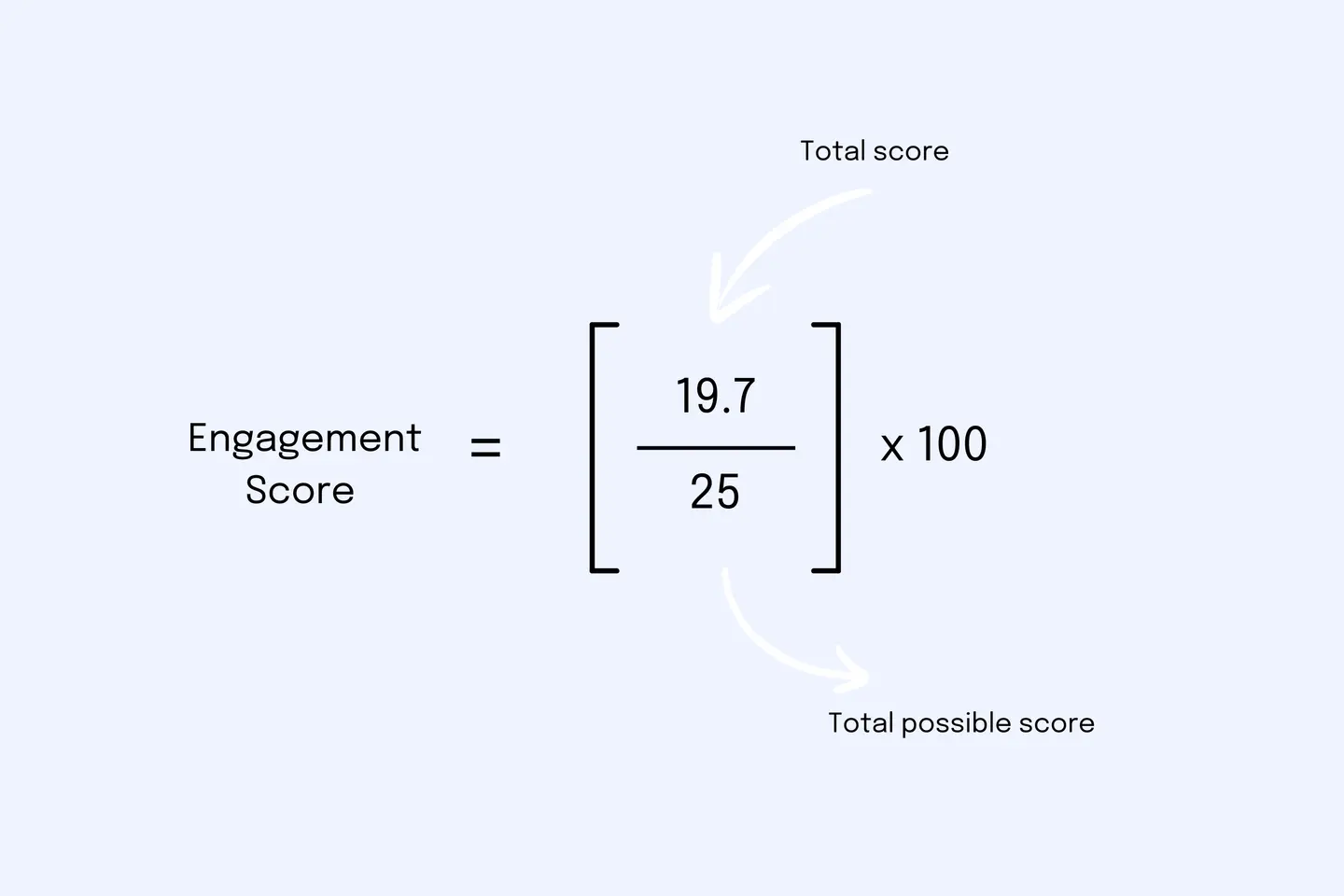
The total score will be 4.2 + 3.8 + 4.0 + 3.6 + 4.1 = 19.7
The total possible score can be 25 (5 questions * 5 max scores per question).
So, the engagement score will be 78.8%
So, coming to a “good” employee engagement score can vary depending on the industry, company size, and specific circumstances of the organization. However, there are some general benchmarks and considerations to help determine what constitutes a good score:
On a normalized scale from 0 to 100, a score above 70 is typically considered good. Scores between 60 and 70 may indicate moderate engagement, while scores below 60 suggest areas needing significant improvement.
In conclusion, it is essential to focus on actionable improvements and openly communicate the results with your employees after determining the employee engagement score. Use the insights to pinpoint areas that need work and create focused plans to deal with any problems. Prioritize comparing your current scores with past performance to track progress, rather than competing with other organizations. This approach ensures you focus on the internal growth and development of the organization.
Frequently asked questions
1. What are employee engagement surveys?
Employee engagement surveys are thoughtful sets of questions that an organization creates to measure all employees' motivation and emotional connection to the organization and its goals. An employee engagement survey can have multiple themed questions and should be run anonymously to get honest feedback from employees.
2. What are the 5 C's of employee engagement?
The 5 C's of employee engagement - Connection, Communication, Congratulation, Care, and Coach. Connection fosters strong relationships among employees, creating a sense of belonging. Communication ensures transparent and open exchanges of information, building trust. Coaching encourages guidance instead of micromanagement. Congratulate recognizes and celebrates employees' achievements, boosting morale and motivation. Care reflects the organization's commitment to employees' well-being and personal growth.
3. How to structure an employee engagement survey?
Structure an employee engagement survey to meet the specific goals of the organization. Run the survey on a regular basis, not just once or twice a year. Make sure the survey is not too long and that employees do not feel survey fatigue. Include multiple themed questions in a survey, with a mix of positive and negative-toned questions. Use a Likert scale rating to measure answers.