

What is a skip-level meeting?
10, 8, 6, 4, next? Right, 2 and we’re here! That was fast. Do you see what we did there? We skipped the numbers so we could start the article sooner. Similarly, you too can skip levels at your organization and hold meetings to get to know or inform of potential issues sooner - before they take the shape of a big problem. Stated simply, you can hold skip level meetings. What is it?
Well, a skip-level meeting is a meeting that is held between a manager and employees who do not report to him or her directly in the absence of the employees’ reporting manager. Employees can be one or more levels below the manager in the management hierarchy. They can be held one-on-one between a manager and an employee or in a group setting between a manager and a group of employees.
Regardless of whether you are a manager or an employee, you must be thinking, "What exactly do I ask during the meeting? If that's the question in your mind, well, we will answer that and add more questions to consider (literally). Let's get started.
Why should I, as manager, hold a skip-level meeting?
"I already hold and attend so many meetings! Why hold another one and add to the time wasted in meetings?" If that’s your question, you are obviously unaware of the advantages a skip-level meeting provides.
- Identify potential issues: As a manager, you are responsible for the performance of your teams, but you may not always have a clear understanding of what is happening on the ground level. This is where skip-level meetings help. By meeting with subordinates who do not directly report to you, you can gain valuable insights into what is happening in their teams.
- Foster trust building: Skip level meetings help build trust between you and your non-immediate subordinates. The open and transparent communication that transpires between you and the employees in the absence of their direct reporting manager aids this, which in turn helps to create a stronger relationship.
- Enhance employee engagement: United we stand, divided we fall. Yep, we know that. But how do we achieve this in our organisation? Through skip-level meetings. When your subordinates feel that their higher-ups care about their opinions and are interested in their success, they are more likely to be engaged and committed to their work.
- Boost productivity: When you actively listen to the feedback shared and the concerns raised by your subordinates, you gain valuable insights into the areas that need fixing and the areas that need to be promoted more for a smoother workflow. Such valuable inputs help in creating the right plan for productivity.
Why should I, as an employee, hold a skip-level meeting?
"I have so much work to do, and now another meeting?" Hold up, we see you. We understand there is so much to do, but trust us when we say that skip-level meetings make your life as an employee a whole lot easier. Read to find out how.
- Receive constructive feedback: When you share your roles and responsibilities with the manager and discuss the work done so far, you are likely to receive feedback and suggestions on how to improve on it. Since the higher-ups have an understanding of how your work aligns with the organisation’s goals, they are in a better position to show you how you can contribute better.
- Identify opportunities for career growth: By meeting with your manager's manager, you gain a better understanding of the organisation's goals and how your work fits into the bigger picture. You can learn about potential career opportunities and how you can develop your skills. In addition, you can share your achievements to get a chance to take on more significant roles in the future.
- Get your voice heard: Skip-level meetings give you an opportunity to give feedback and raise concerns that you may not be comfortable sharing with your immediate supervisor.
- A deeper understanding of team priorities: Skip-level meetings are the right place to understand how your team contributes to the broader goals of the organisation. Meeting with your manager’s manager gives you an insight into what must be done first to achieve them. The discussion you have with the manager not only gives you clarity on the "what" of urgent tasks but also the detailed "why" of them.
Skip-level meeting questions to ask employees
If you're a manager looking to hold a skip-level meeting with your subordinates, here are some essential skip-level meeting questions you may want to consider:
- 1.What do you like the most about the work you are doing?
- 2.What motivates you to do your best?
- 3.What are some of the challenges you face in your work, and how can I help you overcome them?
- 4.How do you think we can improve communication and collaboration within the team?
- 5.What are your future/short-term/long-term plans?
- 6.Is there a new skill that you would like to acquire? how can we as a company assist you in this endeavour?
- 7.What are some of the areas where you think the team can improve?
- 8.Do you feel the project you are working on is challenging enough for you?
- 9.What can be reduced for you to be successful in your current role?
- 10.Are you comfortable with the current office setup? (WFH, WFO, or hybrid)
- 11.If you were the team manager, what change would you bring first and foremost?
- 12.Do you think everyone in your team contributes equally?
- 13.What is your biggest concern about your team?
- 14.How is your overall workload? Do you feel over or underworked? Or is it adequate?
- 15.Is there anything you would like to know about the organisation?
Skip-level meeting questions to ask managers
If you're an employee who wishes to hold a skip-level meeting with your manager's manager, here are some essential questions you may want to consider:
- 1.What are the organisation's goals, and how do they align with my department's goals?
- 2.What are the organisation's most significant challenges, and how can I contribute to addressing them?
- 3.How can I develop my skills and take on more significant responsibilities within the organisation?
- 4.I am really interested in contributing to blog writing (or any other suitable domain for you). Who should I reach out to?
- 5.What are the areas where I need to focus my attention?
- 6.Are there any upcoming projects or initiatives that I can get involved in to help me develop my skills and contribute to the organisation's success?
- 7.Could you please share key milestones and achievements of the organisation?
- 8.What is your biggest challenge as a leader?
- 9.What are your expectations from our team?
- 10.What do you think our team is lacking and can improve on?
- 11.What are some big changes we can expect in the coming months?
- 12.What should my team do more to help achieve organisational goals faster?
- 13.Who do you think can be the best mentor for me?
- 14.On a scale of 1 to 10, how would you rate the team’s recent contributions to the organisation?
- 15.Is there anything you would like to know?
How can Sup Bot help you have a better skip-level meeting?
1. Boost Your Skip-Level Meeting Feedbacks
In any professional setting, time is a valuable resource. We invest hours in meetings, hoping to achieve productive outcomes and make progress. But how do we ensure that the time spent in these meetings is truly valuable to all participants? How do we gauge if our efforts are bearing fruit or simply going to waste?
One effective approach is to gather feedback from meeting participants. By soliciting their insights and opinions, we can gain valuable perspectives on the effectiveness of our meetings. But there's a catch - people may not always provide honest feedback, fearing potential repercussions or simply being hesitant to voice their true thoughts.
That's where Sup Bot comes to the rescue. With Sup's advanced feedback features, you can easily create and distribute feedback forms to all meeting participants. Whether you've met with individuals or groups, you can use the same form to gather their valuable input.
 Add to Slack
 Add to Teams
 Add to Webex
But what about the challenge of honesty? Sup has the perfect solution - anonymous submission. By enabling anonymous feedback, you create a safe and secure environment for participants to share their thoughts openly, without any fear of judgment or consequences. This ensures that you receive genuine feedback, untainted by any hesitations or biases.
Note: Here is a document describing in detail how to create a form.
Create a feedback form
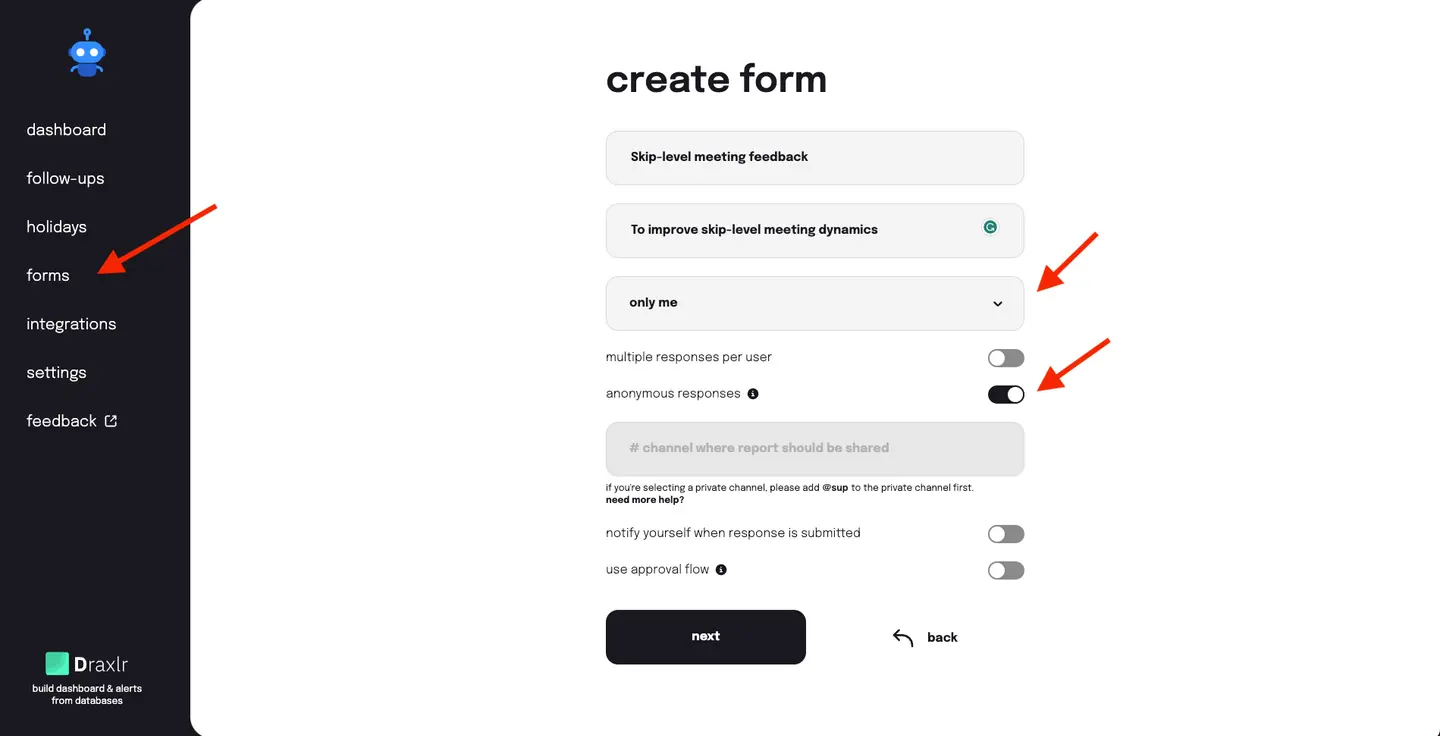
To create a form, navigate to the "Forms" tab in the left navigation bar and click on "Create Form". You will have the option to choose from available templates or create a custom form. When filling out the form details, make sure to address two important points, as highlighted in the screenshot below:
- 1.Set the response destination to "Only Me" to ensure privacy and confidentiality of the responses.
- 2.Enable the "Anonymous Responses" toggle to allow participants to provide feedback anonymously.
Collecting Feedback
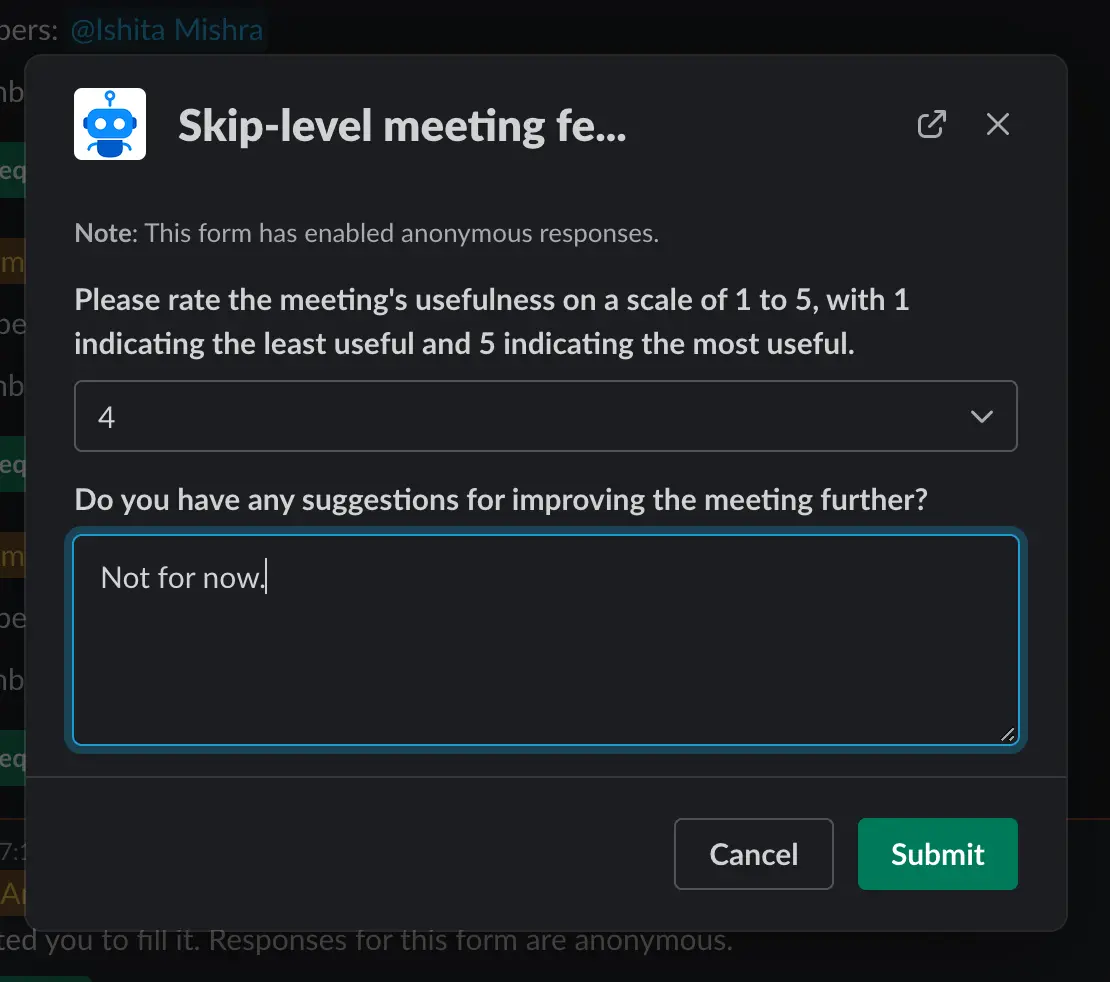
After creating the form, all participants will receive a notification on Slack, similar to the example shown below:

And once the participants click on Fill out form, it will be visible like this
View and Analyze Responses
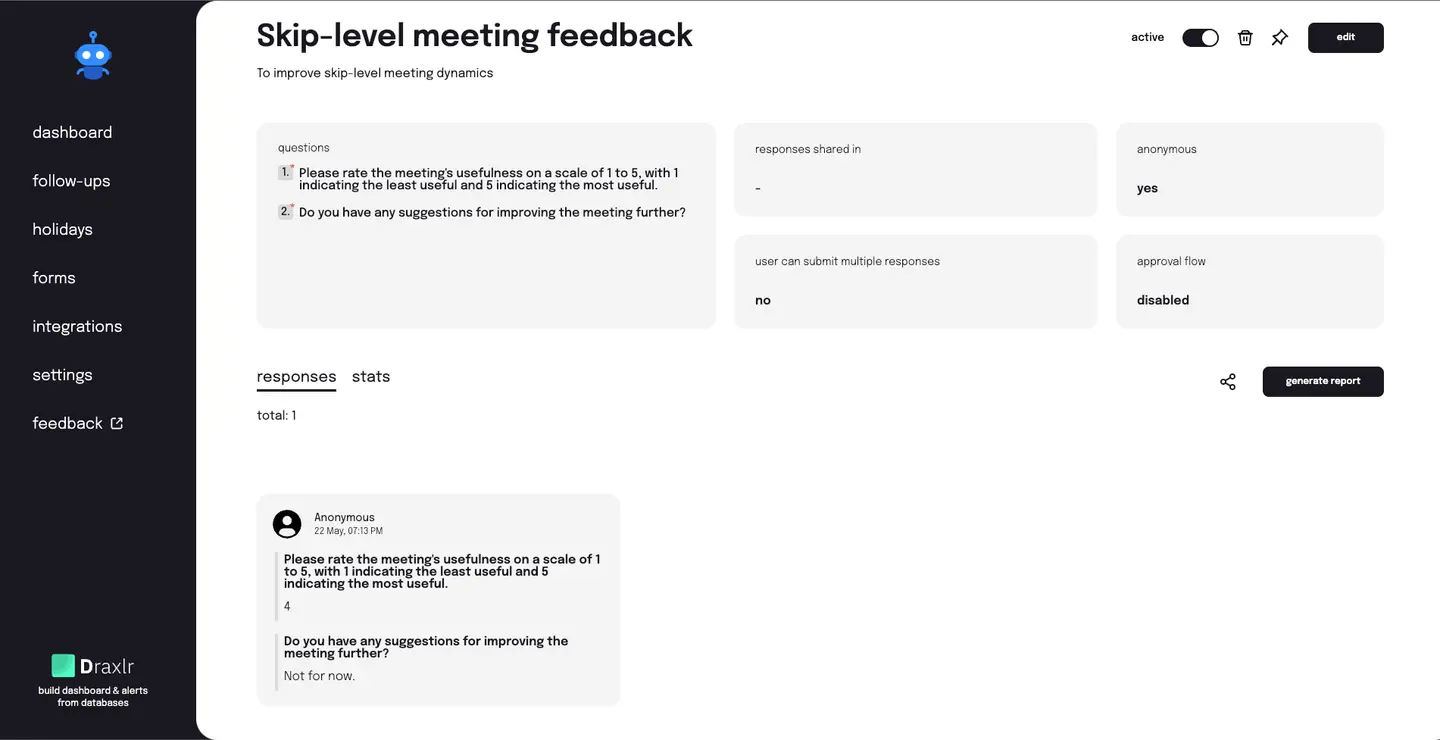
As soon as all of the participants have shared their individual responses, you, as the manager, will be able to view the responses and determine whether or not there is room for improvement. And because you chose to remain anonymous, the responses you receive will not contain any mention of a username.
2. Ask preliminary questions to participants
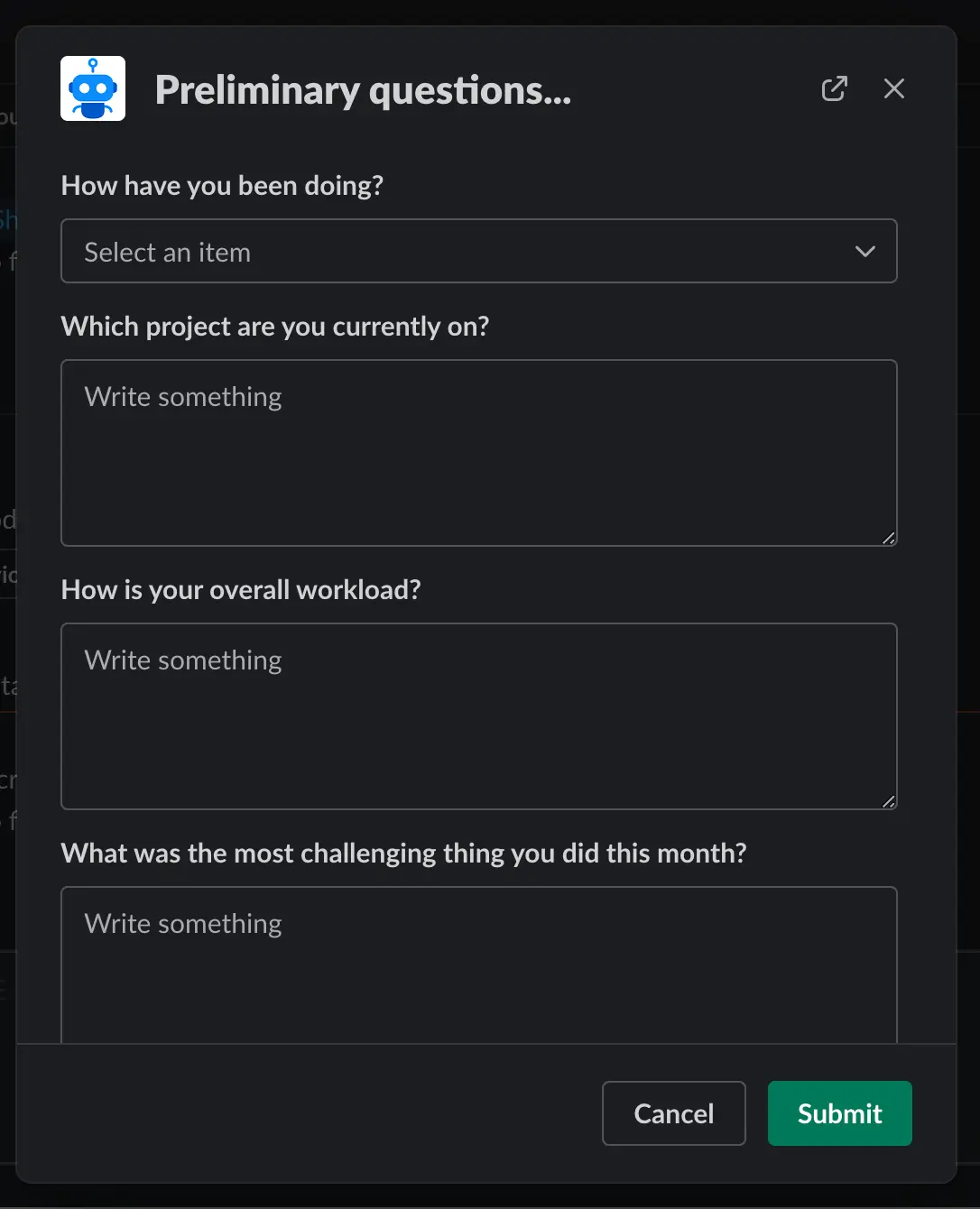
One more way that Sup will be very beneficial to you in your skip-level meeting is that it will allow you to ask a set of preliminary questions to all of the participants, which will provide you with the information you need before the meeting.
The main objective is to serve as a jumping off point for further inquiry into the perspectives, difficulties, and suggestions offered by the participants. By collecting this information in advance, you will be able to tailor the agenda for the meeting, address specific concerns, and foster a discussion that is more meaningful and productive during the skip-level meeting.
At the end of the day
Skip-level meetings can be a valuable tool for managers and employees alike. This is why it is essential to have relevant questions that will help drive the conversation. Managers can even consider starting these meetings with a few check-in questions. We hope the above lists will help you come up with more such questions to ensure that you get the most out of the skip-level meetings.
Frequently asked questions
1. What is the purpose of a skip-level interview?
The purpose of a skip-level interview is to facilitate direct communication between employees and higher-level managers, bypassing their immediate supervisors. This helps in identifying potential issues sooner, fostering trust, enhancing employee engagement, and ultimately boosting productivity. It provides an opportunity for employees to share their concerns, feedback, and ideas directly with senior leadership, promoting a more open and transparent work environment.
2. Is a skip-level meeting good or bad?
Skip-level meetings are generally beneficial to the organization. They help higher management gain a clearer understanding of employee concerns and daily operations directly from the team members. This direct line of communication can lead to quicker problem identification and resolution, improved trust between different levels of the organization, and enhanced overall employee engagement and satisfaction.
3. How do I prepare for a skip-level meeting?
Start by setting clear goals for the meeting to ensure you cover important topics. Prepare thoughtful questions to ask, focusing on areas such as employee concerns, suggestions for improvement, and insights into daily operations. Ensure the environment is conducive to open sharing, encouraging honesty and transparency. Additionally, create a feedback form on Sup Bot to gather structured feedback and follow up on any points discussed during the meeting.
4. Who initiates a skip level meeting?
A skip level meeting is typically initiated by a senior manager or executive who is one or more levels above the immediate supervisor of the employees they wish to meet with. While it is less common, but an employee can also initiate a skip level meeting. This typically happens if the employee feels the need to discuss matters directly with higher management, especially if they believe their concerns or ideas are not being adequately addressed by their immediate supervisor. To do this, the employee should approach the senior manager respectfully, explaining the reason for the meeting request and ensuring it is aligned with the company's culture and policies regarding such interactions.