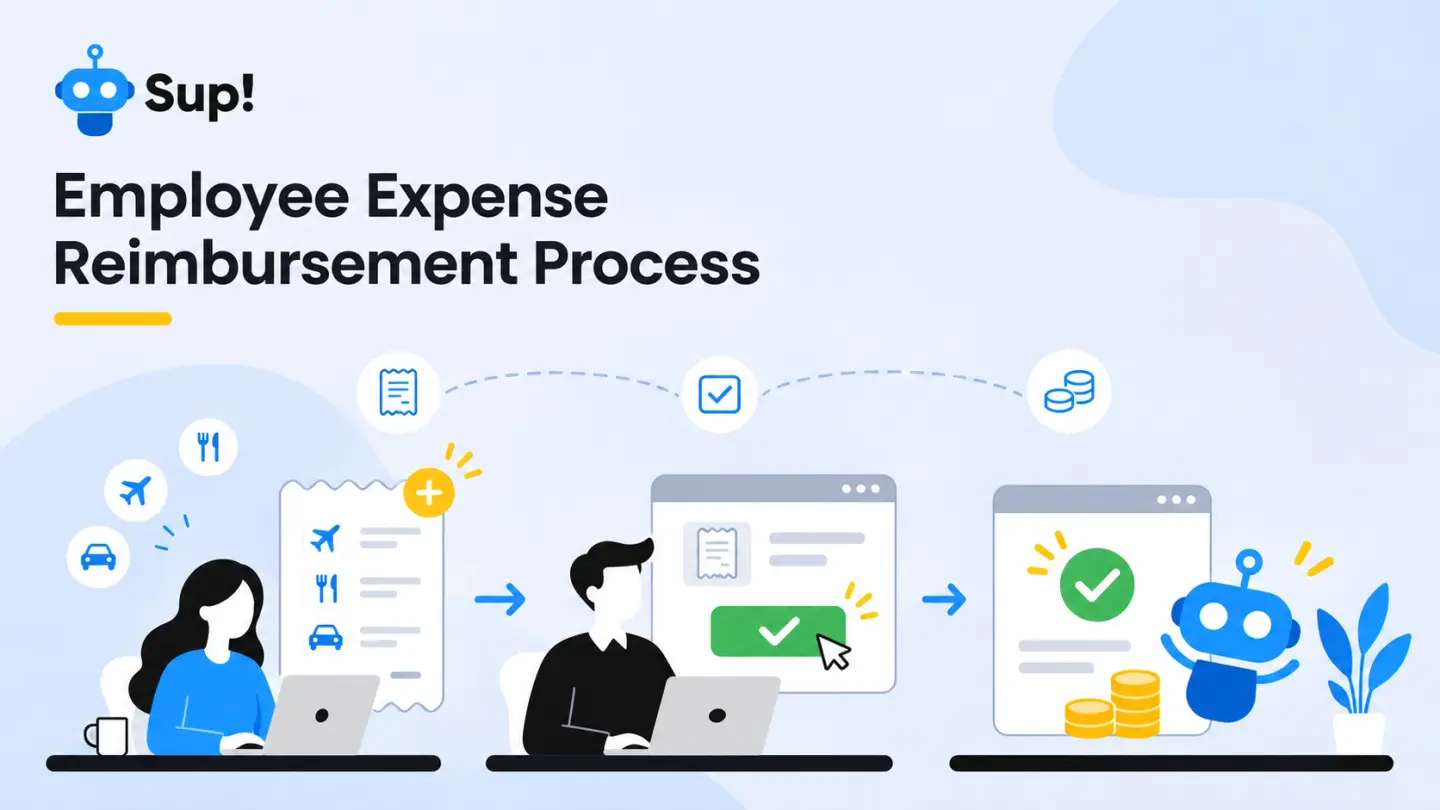
An employee expense reimbursement policy answers a deceptively simple question: when someone spends their own money on company business, how do they get it back? Without clear rules, a straightforward reimbursement can turn into a scavenger hunt for receipts, approval messages, and the person who knows where the spreadsheet lives.
This guide covers policy essentials, approval steps, and two ready-to-use templates so employees, managers, and finance know what to do.
What is an employee expense reimbursement policy?
An employee expense reimbursement policy defines eligible work costs, required evidence, approvers, and payment timing.
It should also explain exceptions, spending limits, and how employees can resolve a rejected or delayed claim. A policy isn't simply a list of eligible purchases. It's a shared process that makes reimbursements predictable and fair.
What expenses should the policy cover?
Categories vary by team. Start with expenses employees genuinely incur on behalf of the business.
| Expense category | Common examples | Suggested policy consideration |
|---|---|---|
| Business travel | Airfare, trains, taxis, hotels | Require advance approval above a set limit |
| Meals | Meals during approved travel or client meetings | Set reasonable limits and require business purpose |
| Equipment | Headsets, keyboards, approved office supplies | Clarify ownership and purchasing authorization |
| Software | Approved subscriptions and work tools | Check for existing company licenses first |
| Mileage and transport | Approved use of a personal vehicle, parking | Define applicable rates and trip records |
| Training | Job-related courses, events, certifications | Require manager approval before purchase |
Also identify non-reimbursable expenses, such as personal purchases, avoidable fines, entertainment unrelated to work, and costs already paid through a company card. Explain how mixed personal-and-business expenses should be separated.
Seven essentials of an employee expense reimbursement policy
1. Eligibility and business purpose
Specify which workers the policy covers and whether contractors follow separate terms. Require each claim to have a legitimate business purpose. Don't assume the same rules apply to every employment arrangement or country.
2. Pre-approval and spending limits
Identify purchases that require approval before employees spend money. State who can authorize them and whether limits apply per purchase, per day, or per trip. If a manager is unavailable, provide an alternate approver.
3. Receipts and required details
Ask for the date, amount, currency, vendor, expense category, business purpose, and receipt or equivalent supporting evidence. For mileage, request the route, purpose, distance, and applicable rate. Define how to handle a genuinely lost receipt.
4. Submission deadline
Set a practical deadline, such as 30 calendar days after the purchase or end of a trip. This is an illustrative company choice, not a universal legal requirement. Explain how late claims are reviewed and accommodate legally required reimbursements.
5. Review and approval
State whether managers validate business necessity and finance checks documentation, duplicates, and policy compliance. Make it clear that a request for additional information is different from a rejection.
6. Payment timing and method
Tell employees how approved claims are paid and the expected timeline, such as the next scheduled reimbursement run. Avoid promising a payment date your finance process cannot reliably meet. Local laws may impose additional requirements.
7. Exceptions, disputes, and recordkeeping
Document who may approve exceptions, how employees can appeal a decision, and where records are stored. Apply access controls and retention schedules appropriate to local legal, tax, and privacy requirements.
Employee expense reimbursement policy templates
Choose between two ready-to-customize options: a detailed policy for teams that need formal controls and a simpler policy for small businesses. Neither is a legally complete policy; have HR, finance, and legal teams review the thresholds and timelines before use.
Option 1: Detailed employee expense reimbursement policy template
Detailed employee expense reimbursement policy
Policy name: Employee Expense Reimbursement Policy
Policy owner: Finance / People Operations
Effective date: To be confirmed internally
Scope: Employees undertaking authorized business activities
1. Purpose
The company reimburses reasonable, necessary, and properly documented expenses incurred for approved business activities, subject to this policy and applicable law.
2. Eligible expenses
Eligible categories may include approved travel, accommodation, business meals, transport, equipment, software, and job-related training. Expenses must be directly connected to company work.
3. Exclusions
Personal purchases, fines, duplicate claims, unapproved discretionary upgrades, and expenses already paid by the company are generally excluded unless applicable law requires otherwise.
4. Authorization
Employees must obtain manager approval before purchases above the company's published spending threshold or within categories designated for pre-approval.
5. Claim submission
Employees should submit claims within 30 calendar days of the expense, attaching an itemized receipt and stating the business purpose, date, vendor, amount, and currency. This deadline is an example and must be reviewed against applicable law.
6. Review and payment
The manager reviews business justification; finance verifies the supporting information. Approved claims are paid through the company's established reimbursement cycle. Employees will be notified if information is missing or a claim is declined.
7. Exceptions and disputes
Employees may request an exception or reconsideration through Finance / People Operations. Exceptions require documented authorization and must comply with applicable law.
8. Records and changes
The company stores reimbursement records according to its retention and privacy policies and may update this policy with appropriate notice.
Before publishing this detailed template internally, add actual limits, named approval roles, the submission channel, payment schedule, and an effective date.
Option 2: Simple employee expense reimbursement policy template for small businesses
Prefer something shorter? This employee-friendly version covers the basics without a lengthy policy document. All amounts and timelines below are examples to customize, not legal requirements.
Simple employee expense reimbursement policy
Company: [Company name]
Effective date: [Date]
Policy owner: HR and Finance
1. Purpose
We reimburse reasonable, authorized expenses employees pay while doing their jobs. This policy explains what qualifies and how to request repayment.
2. Covered expenses
Approved business travel, work-related meals, office supplies, software, training, and client-meeting costs may qualify. Personal purchases, fines, duplicate claims, and unapproved extras generally do not.
3. Approval limits
Obtain manager approval before purchases above ₹5,000. Expenses above ₹10,000 also need Finance approval. These are example thresholds; your company should set its own.
4. Submit a request
Submit within 30 calendar days of the expense. Include the purchase date, amount, category, business purpose, and itemized receipt. Contact Finance if a receipt is unavailable.
5. Review and payment
Your manager reviews the business purpose and Finance checks the details. Approved expenses are reimbursed through the regular payment process, normally within 15 business days after final approval, subject to applicable law.
6. Exceptions and help
For unusual expenses, late claims, or questions, contact [HR/Finance contact]. Any exception needs appropriate authorization.
Choose the detailed template when you need more formal controls, or use this shorter version when straightforward instructions will do. In either case, review the policy against applicable employment and tax laws.
How to make reimbursements easier to manage
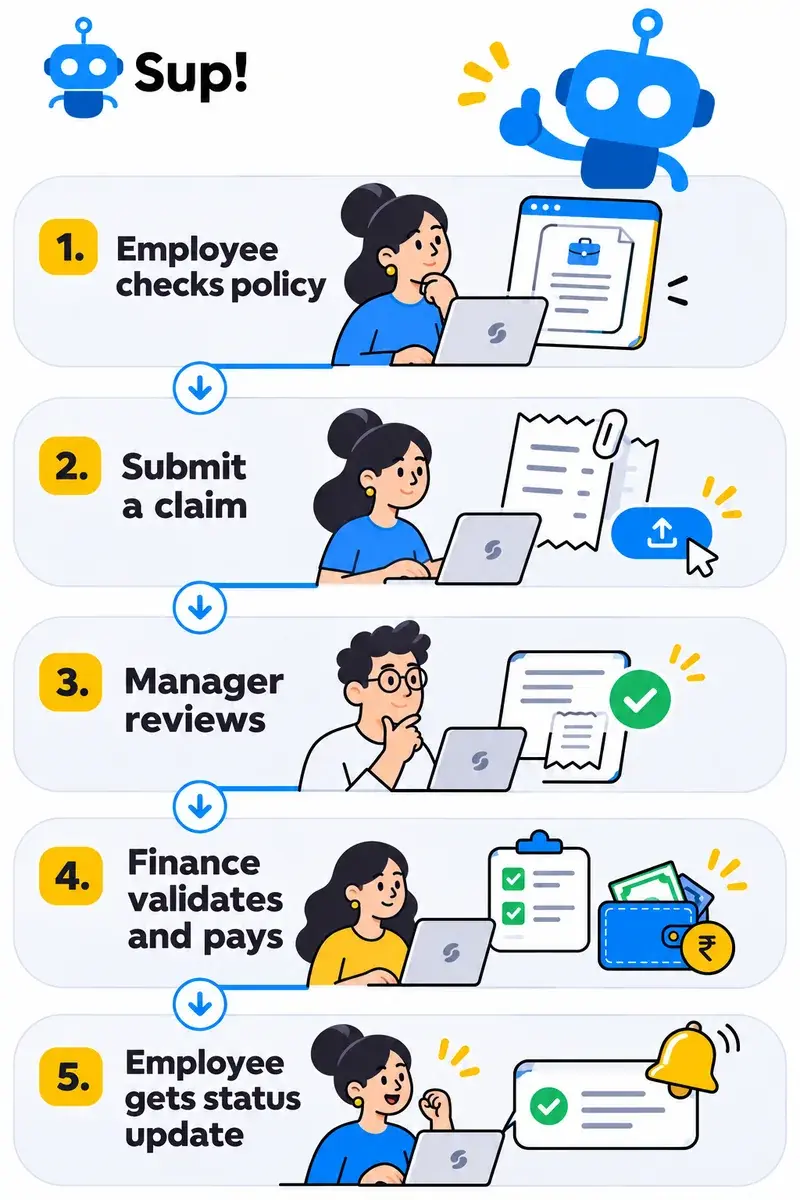
A good policy needs a process that people will actually use. Consider this five-step workflow:
- 1.Employee checks the policy before purchasing and obtains pre-approval where required.
- 2.Employee submits a claim using one standard form with supporting documents.
- 3.Manager reviews the request for business purpose and spending authorization.
- 4.Finance validates and pays the approved amount, recording the transaction.
- 5.Employee receives a status update so they don't have to chase an answer.
For a closer look at setting up each stage, see our guide to the employee expense reimbursement process.
For teams using Slack or Microsoft Teams, the Sup! reimbursement tracking feature makes it easier to manage expenses by allowing employees to submit expense details through forms while allowing managers to view and manage reimbursement requests. This keeps reimbursement information organized in one place, reduces manual follow-ups, and gives teams better visibility into expense requests.
Employee expense reimbursement rules in India
In India, tax treatment depends on the type and purpose of an employee expense. Under Section 10(14) and Income Tax Rule 2BB, qualifying allowances for official travel, daily expenses, and work-related conveyance may be exempt, subject to applicable conditions and actual spending.
Employers should retain receipts, expense details, and evidence of business purpose. Some benefits have additional documentation requirements under Income Tax Rule 3. These tax rules do not establish a universal employee reimbursement deadline.
Common mistakes to avoid
Making rules too vague. “Reasonable expenses” sounds helpful until two managers interpret it differently. Add examples and practical limits.
Treating tax rules as universal. Requirements vary by jurisdiction. In the United States, the IRS distinguishes accountable and nonaccountable reimbursement plans. An accountable plan generally requires a business connection, timely substantiation, and return of excess advances. Reimbursements that fail those requirements can have different payroll-tax treatment. See IRS Publication 15 and Publication 463. Review local rules before adopting a policy.
Conclusion
A useful reimbursement policy makes ordinary work expenses feel ordinary again. Employees know what qualifies and how to submit a claim. Managers have clear approval boundaries. Finance receives consistent information instead of scattered receipts and repeated follow-ups.
Choose the template that fits your team, then tailor the eligible categories, limits, deadlines, and approval roles to your organization. Share the policy in a place everyone can find, test it with a few realistic expense scenarios, and revisit it when your team or working practices change.
 Add to Slack
 Add to Teams
FAQs
Are employers legally required to reimburse employee expenses?
It depends on the jurisdiction and the circumstances. Some laws require reimbursement of certain necessary work expenses, while others have narrower obligations. A company policy cannot override applicable employment law. Have local HR or legal counsel review your policy, especially for remote employees working across different regions.
What happens if an employee loses a receipt?
The policy should offer a documented exception process, such as a written explanation and alternative evidence, where legally and tax-appropriate. Approval should not be automatic. Finance may need additional documentation, and some expense categories have stricter substantiation requirements than others.
How quickly should employees be reimbursed?
Choose a clear, achievable payment schedule and check local legal deadlines. For example, a company might process complete, approved claims during a regular finance run. State when the clock starts, what happens if information is missing, and how employees can follow up on overdue claims.
Can employees claim expenses paid in a foreign currency?
Yes, if the policy permits the underlying expense. Define which exchange rate to use, what date applies, whether card conversion fees qualify, and which currency employees will receive. Ask for the original receipt and any conversion evidence needed to calculate the reimbursable amount consistently.