Fifteen minutes. That's what the daily stand-up was supposed to cost. So why does yours somehow eat forty, and why does everyone spend the first ten apologising to whoever's on mute? Async stand-ups exist because that math stopped adding up a long time ago. Most of what happens in a stand-up is information transfer, and writing is genuinely better at that than talking.
The traditional daily stand-up assumes something distributed teams often don't have: the same place, roughly the same hours, and easy real-time overlap. Bolt that format onto a team spread across four time zones and it quietly becomes the most expensive fifteen minutes of the day. Someone's up at 6am. Someone else gets yanked out of deep focus. And the update itself? Forgotten by lunch, because nobody wrote it down.
Async stand-ups keep the ritual and throw away the calendar invite. Everyone posts their update in their own time, in writing, where it's searchable and easy to refer back to. No mute buttons, no "you go first," and no one performing productivity for an audience.
Let's talk about how to actually run one well, because doing it badly is very easy.
What an Async Stand-up Actually Is
An async stand-up is a daily or recurring team update completed in writing instead of in a meeting. Team members share what they completed, what they're working on next, and any blockers within an agreed time window.
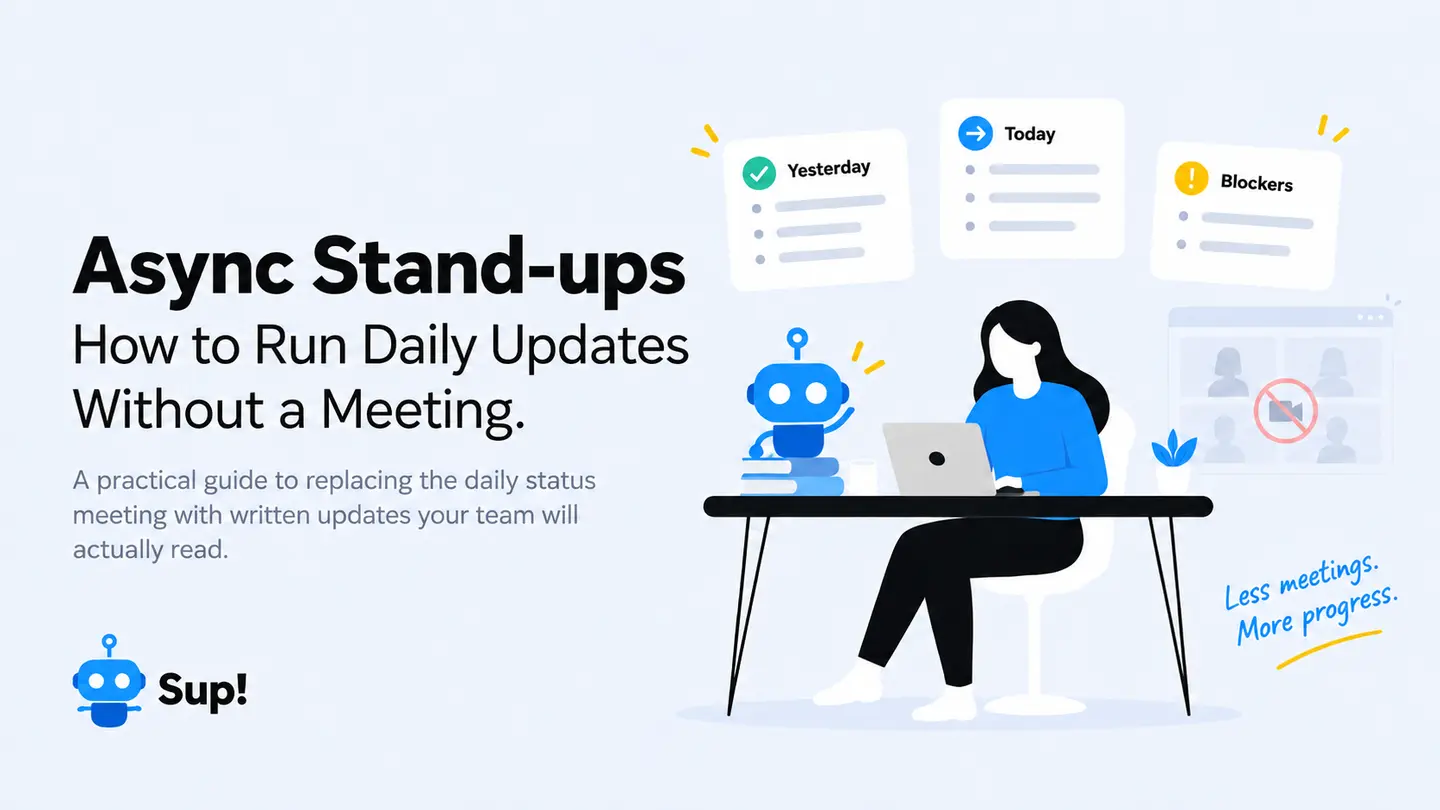
Same three questions you already know:
- What did I get done since my last update?
- What am I working on next?
- What's blocking me?
That's it. No meeting, no round-robin, no dead air. The output isn't a conversation; it's a readable, searchable record of what the team is doing.
The mental shift is small but important: a stand-up isn't a meeting. It's a ritual. The value was never people sitting in a room. It was the rhythm, the visibility, and the moment where someone says, "Actually, I'm stuck."
Async Stand-up Template
If you're setting this up from scratch, keep the template boring.
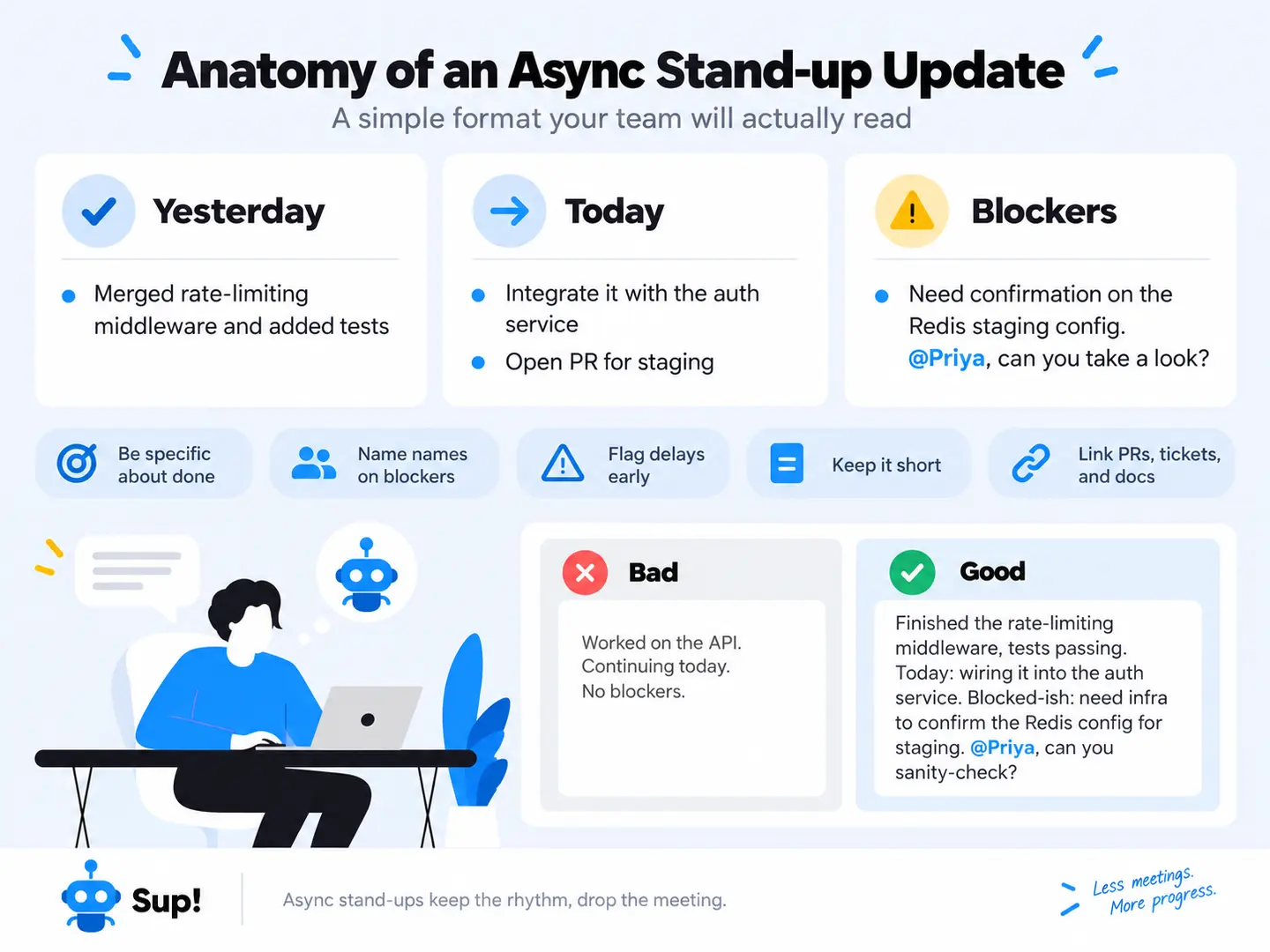
Yesterday
- Merged rate-limiting middleware and added tests

Today
- Integrate it with the auth service
- Open PR for staging

Blockers
- Need confirmation on the Redis staging config. @Priya, can you take a look?
The format doesn't need to be clever. It just needs to make the useful information obvious.
Why the Daily Meeting Stopped Working
A few things break down the moment a team goes remote or distributed:
The time zone tax. With a team spread across even three zones, there's often only a two-hour window everyone shares. Spending your only overlap on status reports is like using your one good conference room for storage.
Interruption cost. A stand-up at 11am doesn't cost fifteen minutes. It can break up the whole morning because nobody wants to start deep work in a block that's about to be cut in half. The meeting becomes a fence around the time on either side of it.
Nothing gets written down. Someone mentions a blocker verbally, three people nod, and by Thursday nobody remembers whose problem it was.
Performance pressure. Talking live rewards the confident and the fast. Some of your best thinkers are neither. Writing gives people more time to think and makes it easier for less vocal teammates to contribute clearly.
Anatomy of an Update People Actually Read
The most common failure mode isn't skipping stand-ups. It's writing updates so vague they're useless.
Compare:
Bad: "Worked on the API. Continuing today. No blockers."
Good: "Finished the rate-limiting middleware, tests passing. Today: wiring it into the auth service. Blocked-ish: need someone from infra to confirm the Redis config for staging. @Priya, can you sanity-check?"
The second one takes ninety seconds longer to write and saves everyone else an hour of guessing.
A few rules that get you there:
- 1.Be specific about "done." "Worked on X" tells us almost nothing. "Shipped X, merged" tells us what changed.
- 2.Name names on blockers. A blocker addressed to nobody is a wish, not a request.
- 3.Flag when you're behind, early. Async stand-ups are for surfacing problems, not hiding them. A team that never posts a blocker isn't necessarily unblocked; it may just be uncomfortable raising one.
- 4.Keep it short. Five bullets, not five paragraphs. If it needs more, it needs a doc.
- 5.Link things. PRs, tickets, docs. One click beats a search.
Picking Your Window
The window matters more than the exact time. Some patterns that work:
- Start-of-day, local. Everyone posts within two hours of starting. Naturally staggered, and no one wakes up early.
- End-of-day, local. Better for teams with a big time gap. The next zone wakes up to a full picture of what happened while they slept.
- Twice a week instead of daily. Genuinely fine for many teams. If your work moves in multi-day chunks, daily updates are just noise with a schedule.
Whatever you pick, write down the expectation. "Post before you start your day" is a norm. "Post whenever" is a slow death.
Where Async Stand-ups Go Wrong
Four failure modes, in rough order of how often they happen:
Nobody reads them. The updates pile up in a channel and become wallpaper. Fix: someone, whether that's a lead or a rotating volunteer, reads and responds daily. One reaction or reply proves the void is listening.
They turn into a surveillance log. If updates are used to catch people slacking, everyone starts writing defensively and the honesty evaporates. Stand-ups are for coordination, not monitoring. Managers who treat them otherwise get exactly the theatre they deserve.
The blockers go nowhere. A raised blocker that sits for two days teaches everyone not to raise blockers. Someone needs to own the follow-up.
Manual chasing. If a human is DMing six people every morning asking for their update, the ritual has a single point of failure, and that person quickly gets tired of running it.
Automation removes that failure point. Instead of relying on a manager to chase updates every morning, a stand-up bot can send the prompts automatically, collect responses, and publish a digest for the team. Sup does exactly that, so the ritual keeps running without somebody having to administer it every day.
 Add to Slack
 Add to Teams
 Add to Webex
You Still Need Some Live Time
Async stand-ups aren't a vow of silence. Written updates handle status brilliantly, but they handle ambiguity badly. Keep real-time communication for the things that need it:
- A weekly team sync for direction, decisions, and the stuff that needs tone
- Ad-hoc calls when a thread has clearly stalled
- One-on-ones where nuance, feedback, or sensitive topics need real conversation
- Active incidents, where rapid coordination matters more than waiting for the next async check-in
The point of moving status async is to free up your live time for conversations that deserve it. If you cancel the stand-up and fill the gap with three other meetings, you've achieved nothing.
For more on drawing that line, see our guide on synchronous vs asynchronous communication.
How to Know It's Working
Watch for these after a month:
- Participation without nagging. If people post unprompted, the ritual has taken root.
- Blockers appearing early. Counterintuitively, more blockers can be a healthy sign. It means people trust the channel enough to surface problems.
- Fewer "what's the status of..." DMs. The record is doing its job.
- Longer uninterrupted blocks on calendars. That's the whole point.
- Fewer status meetings and interruptions. If you've moved the stand-up async but the number of status-check DMs and meetings hasn't fallen, you've changed the format without solving the problem.
If none of that shifts, the format may be wrong for your team, not the concept. Adjust the questions or the cadence before you give up.
Wrapping Up
Async stand-ups keep everything the daily meeting was actually good for: visibility, rhythm, and a place to say "I'm stuck." They drop the part where five people wait in silence for someone's audio to work.
Write updates that are specific, name your blockers, agree on a window, and make sure somebody's reading.
The version that fails is the one where updates get shouted into a channel nobody opens. The version that works is boring, reliable, and quietly gives everybody their mornings back.
Try it for two weeks with one team before rolling it out everywhere. If you want more on building rhythms that survive contact with a busy quarter, have a look at our guide to remote team rituals.