Somewhere right now, a developer is 40 minutes deep into a tricky bug when a message pops up: "quick call?" And just like that - poof - the mental model they spent half an hour building evaporates. The call takes six minutes. The recovery takes twenty-three. That tiny moment is the entire synchronous vs asynchronous communication debate in a nutshell.
Every message you send lands somewhere on a spectrum between "I need you right now" and "get to this whenever your brain has room." Most teams never think about where on that spectrum a message belongs. They just... send it. And then wonder why nobody's shipping anything.
Here's the good news: this isn't a personality problem or a discipline problem. It's a routing problem. Some conversations genuinely need everyone in the same room (or the same Zoom). Others need exactly the opposite - space, silence, and a written trail. The teams that feel calm and fast aren't working harder. They've just gotten good at telling the two apart.
Let's break down which is which.
What Synchronous Communication Actually Is
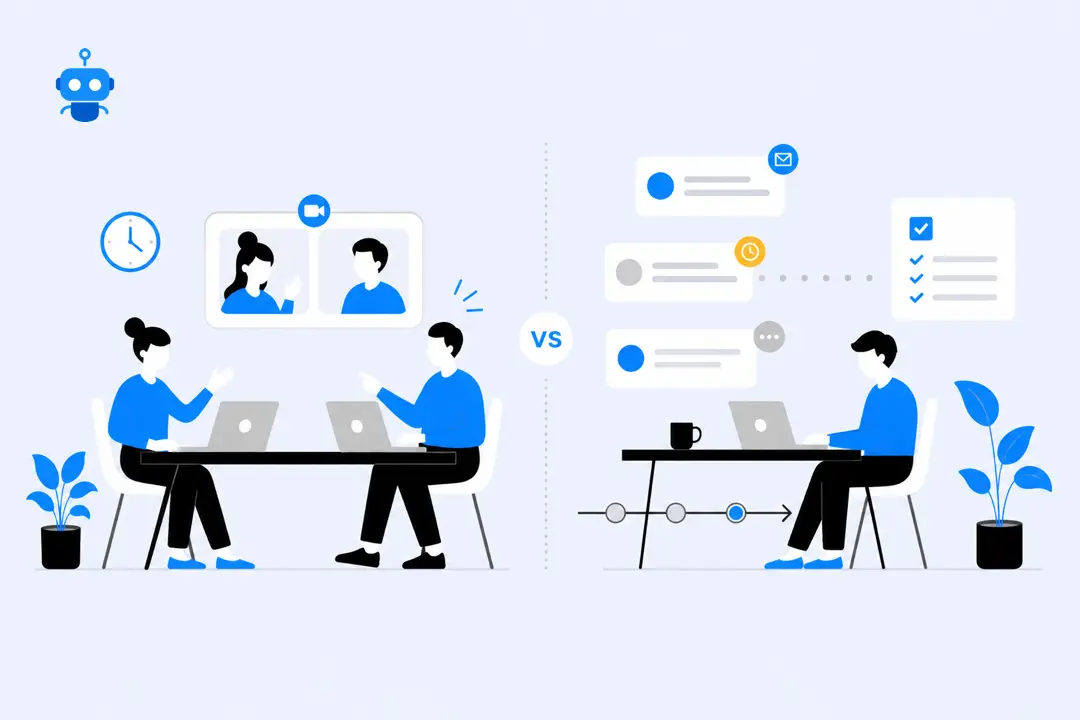
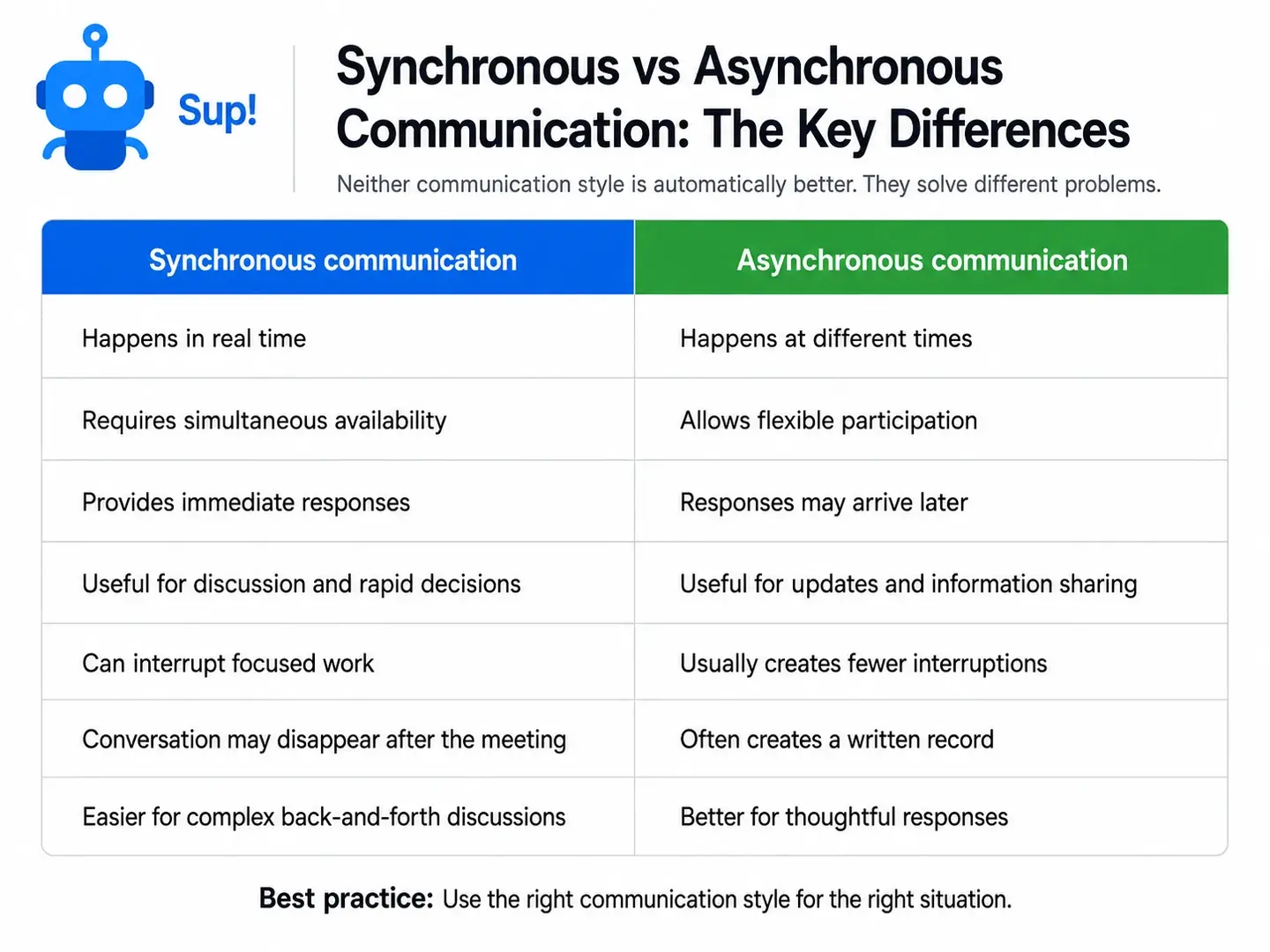
Synchronous or "real-time" communication is anything where everyone's attention has to overlap. You talk, they respond, the conversation moves at the speed of the room.
That includes:
- Video calls and stand-up meetings
- Phone calls and huddles
- In-person conversations
- Live chat where both people are typing in real time
- Pair programming and whiteboard sessions
The superpower of sync is bandwidth. Tone, hesitation, a raised eyebrow, the "wait, say that again" - you get an enormous amount of signal per minute. Ten messy ideas can collide and turn into one good one in ten minutes flat.
The cost is that sync communication is expensive. A 30-minute meeting with eight people isn't 30 minutes. It's four hours of collective human attention, plus the ramp-up before and the mental reset after. Sync is a premium resource. Spend it like one.
What Asynchronous Communication Actually Is
Asynchronous communication is anything that doesn't require an immediate response. You send, they read when it works for them, they reply when they've thought about it.
That includes:
- Written updates and status posts
- Email and threaded chat
- Recorded video walkthroughs (Loom-style)
- Docs, wikis, and comments on a PR
- Async stand-ups where everyone posts their update in their own time
The superpower of async is depth. People get to think before answering. Quiet team members get equal airtime. Everything is written down, which means it's searchable six months later when nobody remembers why you chose Postgres.
Async also does something sync fundamentally can't: it lets people protect long, uninterrupted blocks of focus. And focus is where the actual work happens.
The Real Cost of Getting the Mix Wrong
When teams lean too hard on sync, the symptoms are pretty recognizable:
- Calendars that look like a game of Tetris nobody's winning
- "This meeting could've been an email" said out loud, in the meeting
- People doing their real work at 7pm because the day was meetings
- Decisions that get made three times because nobody wrote them down
Lean too hard the other way and you get different problems: threads that sprawl for four days over a decision two people could have settled in five minutes, ambiguity that festers, and teammates who feel oddly isolated even though there are 200 unread messages.
Research on attention has consistently found it takes a long time to fully return to a task after an interruption - the widely cited figure is around 23 minutes. Whether or not that exact number holds for your team, the direction is obvious to anyone who's ever been pulled out of flow. Interruptions aren't free, and treating them as free is the single most expensive habit in modern knowledge work.
When to Use Synchronous Communication
Reach for real-time when the conversation is high-ambiguity, high-emotion, or high-stakes. Specifically:
- 1.Anything sensitive or personal. Performance feedback, conflict, bad news, "we need to talk about the roadmap." Written words are terrible at carrying warmth. Don't make people decode tone from a paragraph.
- 2.Brainstorming and early ideation. When you have no idea what the answer is, you want messy back-and-forth. Async is too slow for that kind of collision.
- 3.Untangling a stuck decision. If a thread has been going for two days and positions haven't moved, that's your cue. Fifteen minutes on a call beats forty more messages.
- 4.Crisis and incidents. Production is down. Nobody's writing a doc. Get in a room.
- 5.Relationship-building. Onboarding a new hire, team socials, one-on-ones. Connection is a real-time thing.
A useful rule: if you'd need more than three rounds of back-and-forth to sort it out in writing, just talk.
When to Use Asynchronous Communication
Default to async when the conversation is informational, considered, or spread across time zones:
- 1.Status updates and stand-ups. The daily "what I did, what I'm doing, what's blocking me" almost never needs everyone's live attention. It needs to be written down and readable.
- 2.Anything that needs research. Give people time to check the data instead of forcing an off-the-cuff answer.
- 3.Decisions with a paper trail. Architecture choices, policy changes, budget calls. Future-you will want to search this.
- 4.Distributed teams. If your team spans time zones, sync-by-default quietly makes someone's life miserable. Usually the same someone.
- 5.FYIs and broadcasts. Announcements don't need a meeting. They need a well-written message.
This is where async stand-up tools earn their keep. Something like Sup runs the recurring rituals - stand-ups, check-ins, PTO and leave tracking - right inside Slack, so updates get posted, collected, and shared without anyone blocking off a calendar slot. The ritual survives. The meeting doesn't. That's usually the trade you actually wanted.
 Add to Slack
 Add to Teams
 Add to Webex
A Quick Filter: The Two-Question Test
Before you hit "quick call?", ask yourself:
- 1.Does this need a response in the next hour? If no → async.
- 2.Would this be better with tone, or better with a written record? Tone → sync. Record → async.
Two questions. Ten seconds. It'll route about 90% of your messages correctly, and it'll save your team a genuinely absurd number of hours.
Making the Hybrid Actually Work
Most teams don't need to pick a side - they need clear norms so people stop guessing. A few that punch above their weight:
- Set response-time expectations by channel. DM = same day. Email = 24 hours. Tagged in a thread = when you get to it. Written down, so nobody's anxious.
- Default to public and written. If it's in a channel instead of a DM, three other people learn something for free.
- Every meeting gets an agenda, or it gets cancelled. No agenda means nobody knows why they're there - including the organizer.
- Protect focus blocks openly. Shared no-meeting hours beat everyone individually hiding.
- Every sync decision gets an async summary. If it isn't written down, it didn't happen.
- Ask "who actually needs to be here?" The answer is almost always fewer people than you invited.
Wrapping Up
Synchronous vs asynchronous communication isn't a battle where one side wins. It's a routing decision you make dozens of times a day, usually on autopilot - and autopilot tends to over-index on "let's just hop on a call."
Sync is for ambiguity, emotion, and urgency: brainstorms, conflict, incidents, human connection. Async is for everything considered, documented, or distributed across time zones: status updates, decisions, research, announcements. Get that split right and your team gets two things at once - fewer interruptions and better conversations, because the meetings that remain are the ones that deserved to happen.
Start small. Pick one recurring meeting this week and try running it async instead. Watch what happens to your team's afternoons.
Want more on building calm, high-output remote teams? Check out our other guides on async stand-ups, remote team rituals, and keeping culture alive across time zones.