
Every remote team has a graveyard. In it: the Friday quiz that ran twice, the "virtual coffee" calendar invite nobody accepted after March, and the Slack channel called #watercooler with eleven messages, all from the same person, all from 2023. Remote team rituals fail surprisingly often, and it's almost never because the team didn't care. They fail because somebody confused a ritual with an event.
An event is a thing on a calendar. A ritual is something that happens whether or not anyone's feeling enthusiastic that week. It's small, repeated, low-effort, and woven into how the team already works. Weddings are events. Saying "morning" when you sit down is a ritual. One happens occasionally. The other quietly shapes how a group behaves every day.
The good news is that rituals are cheap. They don't need a budget, an offsite, or a Head of Culture. They need a shape, a rhythm, and roughly ninety seconds of someone's attention. Teams that feel genuinely connected across countries often have a handful of tiny rituals running quietly in the background.
Let's look at what makes them work, and how to build ones your team won't quietly abandon.
Why Most Remote Team Rituals Don't Last
Four causes, and you've probably met all of them.
They cost too much. A 60-minute mandatory social call is expensive. Anything expensive gets skipped the first busy week, and once skipping becomes normal, the ritual starts disappearing.
They're synchronous by default. If your ritual requires eight people to be online at the same time and your team spans time zones, someone is almost guaranteed to miss out. That person stops showing up. Then two more.
They're performative. "Share a fun fact about yourself!" makes people feel like they're at a corporate onboarding, not talking to colleagues. Forced vulnerability is one of the fastest ways to make a team clam up.
Nobody owns them. A ritual with no owner is a ritual that ends the moment its unofficial champion gets busy.
The fix for all four is roughly the same: make it small, make it async-friendly, make it optional-but-visible, and give it a home that isn't one person's memory.
Four Types of Remote Team Rituals Worth Building
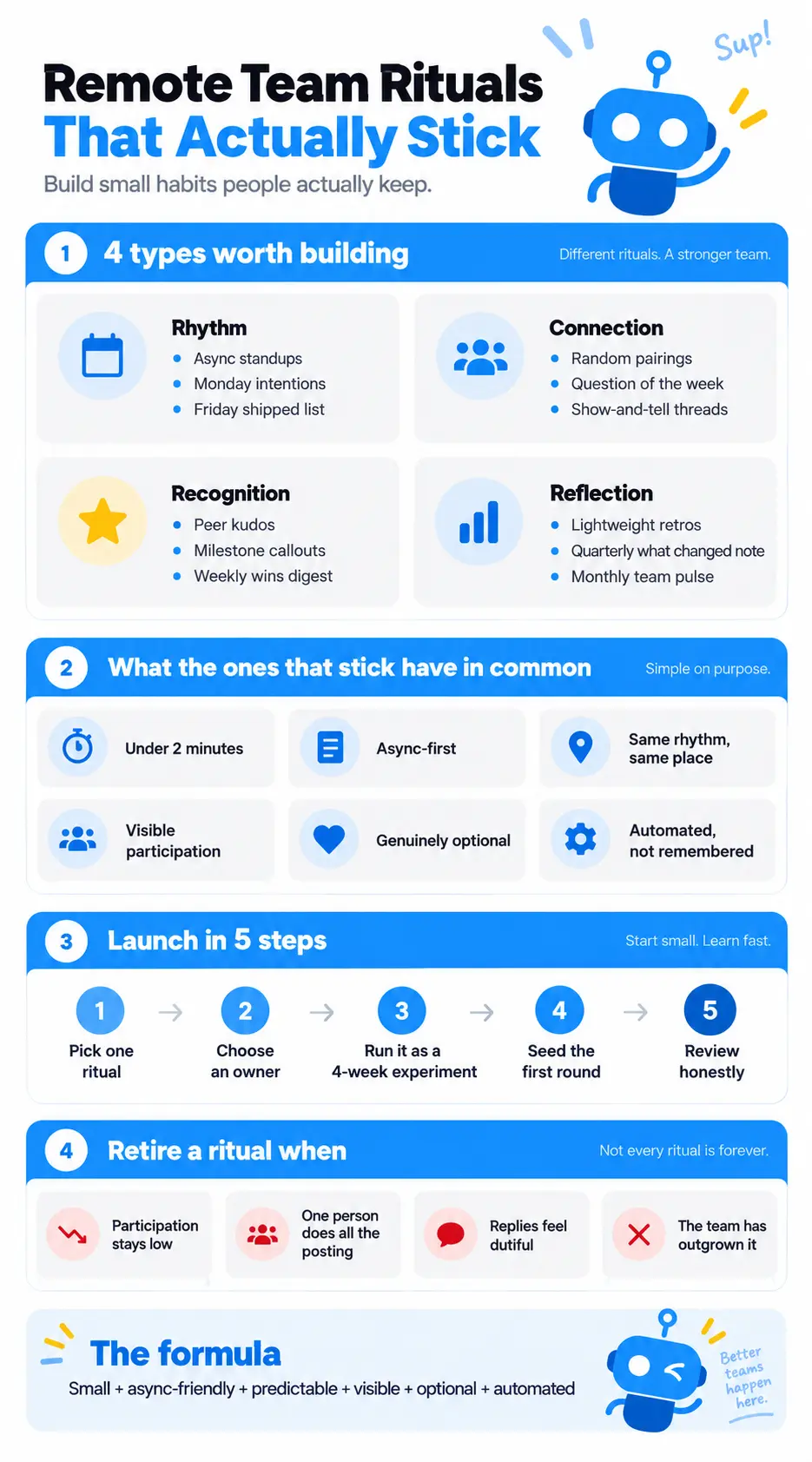
Most healthy remote teams benefit from having something in each of these buckets. You don't need many. One per bucket is plenty.
Rhythm rituals
These give the week a shape so it doesn't blur into one long Tuesday.
- Async standups. A daily written check-in that gives everyone visibility without adding another meeting. If you're setting one up, our async standups guide covers how to make them work without becoming another chore.
- Monday intentions. One line each: what's the one thing you want to land this week?
- Friday shipped list. A channel or thread where people post anything that went live that week. Remote work can make progress surprisingly invisible. This makes it visible again.
Connection rituals
These replace some of the accidental hallway conversation that remote work removed.
- Random pairings. Two people get matched for a 20-minute chat with no agenda. Rotate weekly or biweekly.
- A question of the week. Post one prompt to a channel and let people answer whenever they want. Keep the questions light and specific. "Worst haircut you've ever had" beats "What motivates you?" Specific questions get stories. Abstract ones get silence.
- Show-and-tell threads. Share what you're reading, cooking, building, watching, or listening to. Photos usually beat paragraphs.
Recognition rituals
Recognition is easy to overlook when good work happens quietly across different locations and time zones. A small ritual can make that work visible.
- Peer kudos. Give anyone a lightweight way to publicly thank anyone else. No manager approval. No nomination form.
- Milestone callouts. Celebrate work anniversaries, a first shipped feature, a first customer win, or the first on-call shift survived.
- Weekly wins digest. Recognition compounds when it's visible in one place instead of scattered across DMs.
Reflection rituals
Not every ritual needs to be social. Some should help the team notice what's changing.
- Retros that aren't only after disasters. Run a lightweight monthly reflection around questions like, "What should we stop doing?"
- Quarterly "what changed" note. Remote teams can lose institutional memory quickly. Writing down the important changes gives everyone a shared reference point.
- Monthly team pulse. Ask one simple question: "What should we do more of, less of, or differently next month?" Keep the responses short and visible.
What Remote Team Rituals That Stick Have in Common
Look at a ritual that's lasted and you'll usually find most of these traits.
1. Under two minutes to participate
If it takes longer than making tea, it needs a very good reason. The easier a ritual is to join, the easier it is to keep doing during busy weeks.
2. Async-first
Anyone should be able to participate later, from any time zone. Live participation can be a bonus, but it shouldn't be a requirement.
3. Same rhythm, same place
Monday means Monday. The thread lives in the same channel every time. The prompt shows up where people expect it. Predictability is most of the magic. A ritual that constantly changes location or timing becomes something people have to remember rather than something they naturally notice.
4. Visible participation
People are more likely to join when they can see others joining in. An empty thread feels like work. A thread with five replies feels like a conversation already happening.
5. Genuinely optional
The moment attendance is tracked, the ritual becomes a task. Tasks aren't rituals. People should be able to skip a week without explaining themselves or finding a red mark next to their name.
6. Automated, not remembered
A recurring ritual shouldn't depend on someone remembering to start it every week. Automate the prompt wherever possible. Tools like Sup can schedule recurring check-ins, feedbacks and team questions inside Slack, so the ritual still happens during the weeks when everyone is slammed. That's often the exact week a manually run ritual would otherwise disappear.
 Add to Slack
 Add to Teams
 Add to Webex
How to Launch a Remote Team Ritual Without It Flopping
A simple rollout works better than a big culture initiative.
- 1.Pick exactly one. Not four. Choose one ritual, one bucket, and give it one month. Launching several "culture initiatives" at the same time starts to feel like a management campaign, and people can smell a campaign.
- 2.Find the owner first. The owner doesn't need to be a manager. In fact, it can work better when it isn't. Choose someone willing to personally start the first few rounds and keep the ritual moving while it finds its feet.
- 3.Announce it as an experiment. Say: "We're trying this for four weeks, then deciding whether it's worth keeping." That removes the pressure and makes it safe to retire the ritual if nobody finds it useful.
- 4.Seed it. The owner should post first and make the kind of contribution they want everyone else to make. Nobody wants to be the first reply to an empty thread.
- 5.Review it honestly after four weeks. Look at who participated, how often they participated, and whether the ritual produced anything useful. If three people joined and two were the organiser's teammates being polite, retire it. That's a successful experiment, not a failed culture initiative.
Know When to Retire a Ritual
This is the part teams often skip. Rituals accumulate like browser tabs, and eventually everyone feels vaguely guilty about the ones they're ignoring.
As a rough rule, consider retiring a ritual when:
- Participation has stayed below roughly a third of the team for a month
- The same person is doing almost all the posting
- People still participate, but the responses have become one-word and dutiful
- The ritual made sense when you were eight people, and you're now thirty
Announcing, "We're retiring the Thursday quiz. It had a good run," is a healthy, culture-positive act. It tells the team that the rituals you do keep are being kept on purpose. A ritual shouldn't survive because everyone feels too awkward to stop it.
Wrapping Up
Remote team rituals aren't about manufacturing fun. They're about giving a distributed team a shared rhythm, a way to see each other's work, and a habit of saying thank you out loud.
The rituals that last tend to be small, async-friendly, predictable, automated, and genuinely optional. The ones that disappear tend to be big, live, mandatory, and dependent on one person remembering.
Start with one.
Give it four weeks and an honest review.
If you're not sure where to begin, start with recognition. It's easy to run, takes almost no time, and makes good work visible.
And if your team is spread across a lot of clocks, our guide to keeping culture alive across time zones digs into the specific problems distance creates and the habits that can help solve them.