
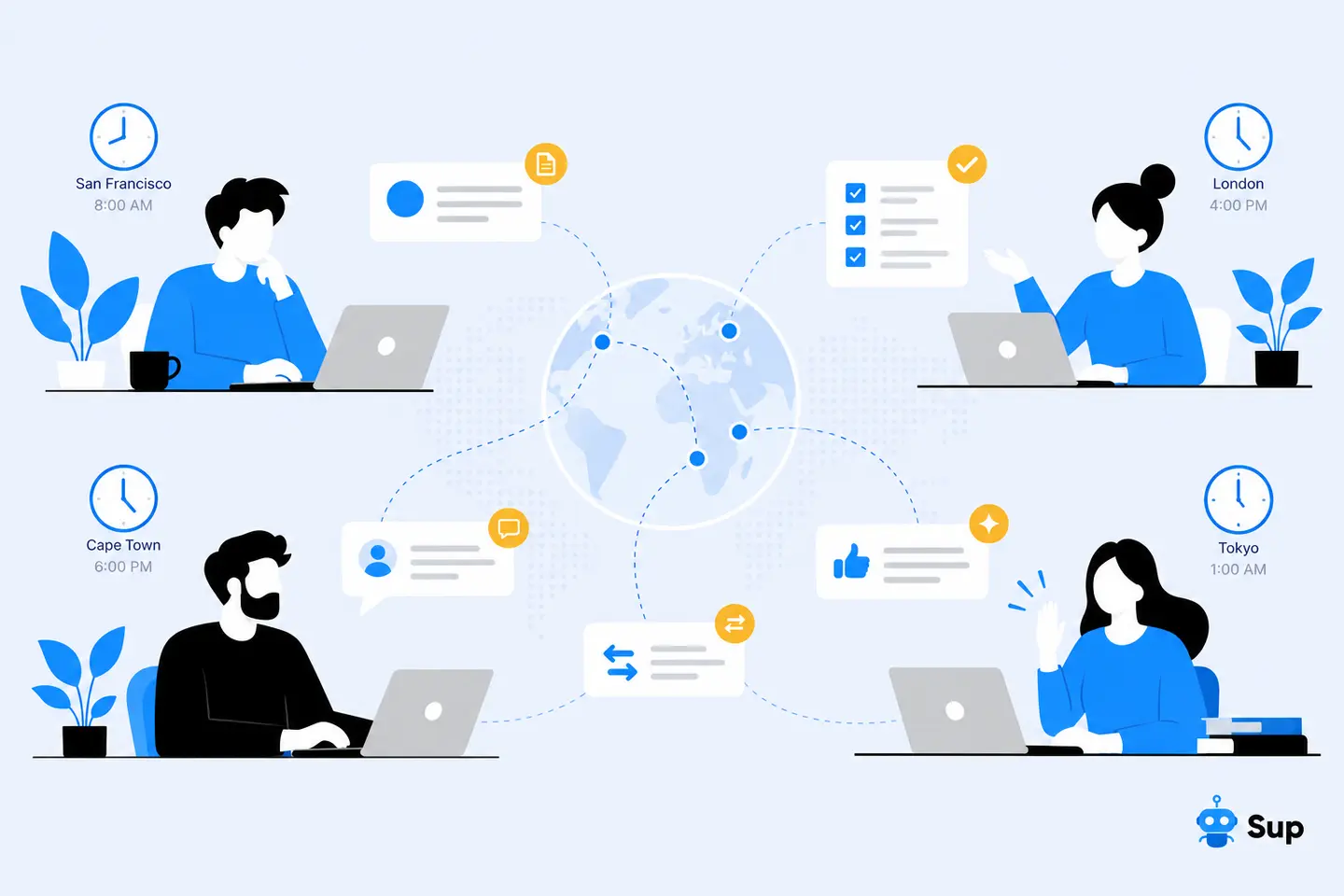
There's a specific kind of loneliness that only distributed teams produce. Building remote team culture across time zones means accounting for moments like this: you log on, and the channel is already 200 messages deep. A decision got made. A joke happened. Someone shipped something. All of it while you were asleep, and all of it now scrolled past: technically available to you, practically gone.
Keeping culture alive across time zones is mostly the work of making sure that experience doesn't become somebody's whole job. Because here's what actually erodes distributed teams: not distance, but asymmetry. When two people share a city and a third is nine hours out, the first two accidentally become the centre and the third becomes the person who gets told things. Nobody decides this. It's just gravity.
Left alone, it turns into a headquarters-and-satellites team where one group makes decisions and another group reads about them. The fix isn't more meetings. That's the trap. It's building a team where being awake at the same time isn't a prerequisite for belonging.
That takes a handful of deliberate habits, and they're all learnable.
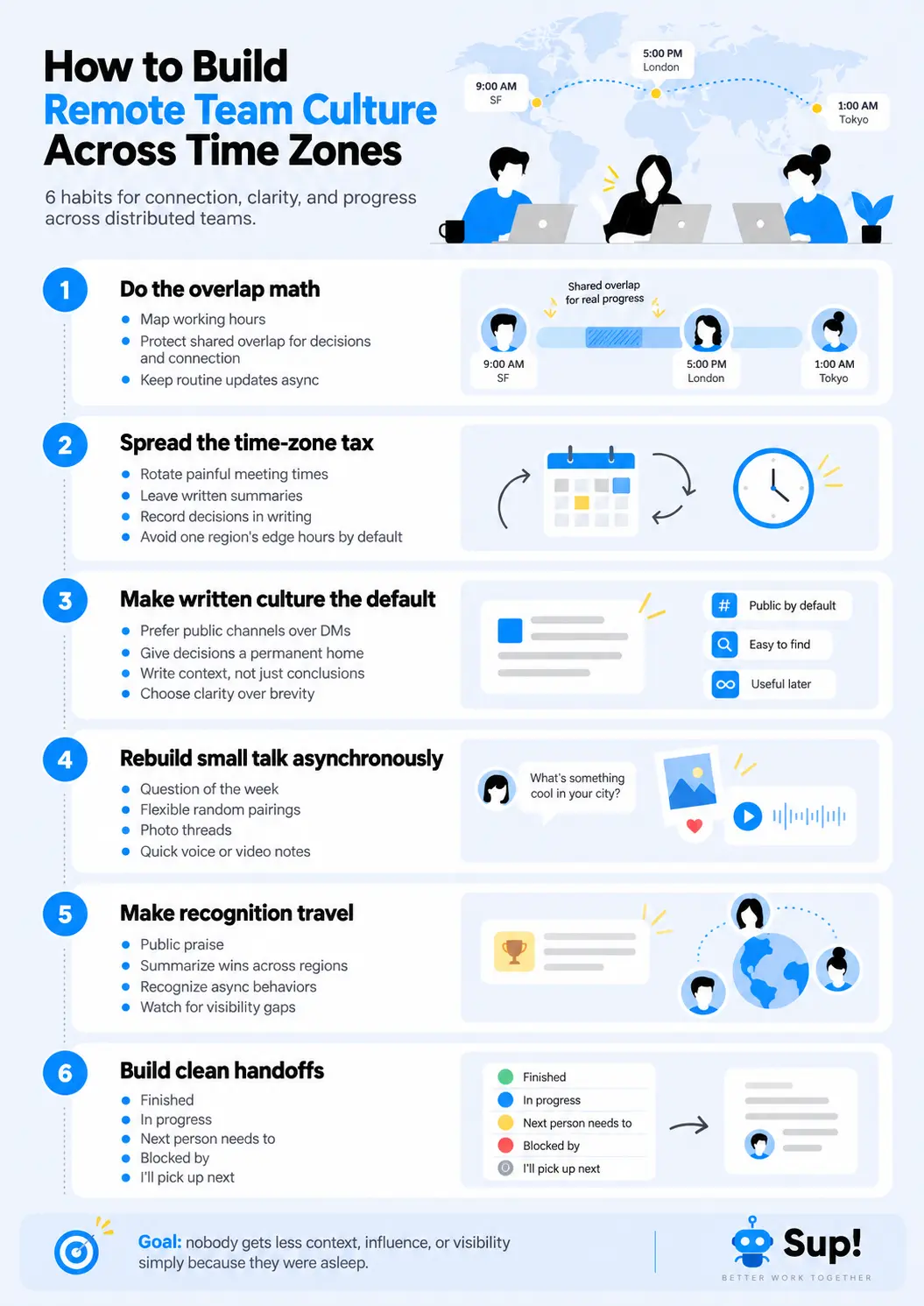
First, Do the Overlap Math
Before anything else, actually calculate your team's shared hours. Not "we're pretty spread out." Find the number.
Line up everyone's working hours in their local time and find the intersection. Teams usually discover one of three situations:
- Four or more overlap hours. Comfortable. Sync is available when you genuinely need it.
- One to three hours. Common, but it requires discipline. This overlap is precious, so don't burn most of it on routine status updates.
- Zero overlap. Workable, but only with a strong async system. Half-async with no overlap quickly becomes frustrating.
Write the number down and share it. Then decide what that overlap is actually for. Use it for things that benefit from live interaction: resolving disagreements, difficult decisions, brainstorming, sensitive conversations, or relationship-building.
Routine updates, handoffs, documentation, and straightforward decisions can usually happen asynchronously. If you're unsure which work belongs where, our guide to synchronous vs asynchronous communication breaks down when each mode works best.
Everything else in this guide is downstream of knowing how much overlap you actually have.
Notice Who's Paying the Time Zone Tax
Somebody on your team might be taking calls at 10pm. The problem starts when it's consistently the same person, usually the person furthest from wherever most of the team or leadership happens to live.
A distributed team shouldn't quietly make one region absorb the inconvenience of being distributed. Here are a few ways to spread that cost.
- 1.Rotate meeting times. If a recurring sync is painful for one region, alternate the schedule. It's slightly inconvenient for several people instead of consistently disruptive for one person.
- 2.Leave a record of important meetings. Any meeting that affects people who couldn't attend should leave behind a written summary. Record it too when useful and appropriate, but don't make the video the only record. Very few people want to watch 45 minutes to find the three minutes they needed.
- 3.Never let the meeting be the only place a decision exists. Decisions can be discussed live, but the outcome, reasoning, and next steps should be confirmed in writing. For decisions that affect people in other time zones, give them a reasonable window to add context or raise concerns.
- 4.Don't schedule critical work in one region's edge hours by default. If your only overlap is someone's 8pm, treat that as a constraint, not a permanently available meeting slot.
The goal isn't to eliminate inconvenience. That's impossible on a globally distributed team. The goal is to make sure the inconvenience isn't always somebody else's.
Make Written Culture the Default
In a co-located team, information lives in the air. In a distributed one, air doesn't reach. So the important parts have to live in text.
- Public over private. A conversation in a channel is a conversation three other people can learn from. The same conversation in a DM is a private cache that expires.
- Decisions get a home. A doc, a channel, a wiki, or another consistent system. "It's in a thread somewhere" isn't a system.
- Write the context, not just the conclusion. "We're going with Postgres" ages badly. "We're going with Postgres because X, and we rejected Y because Z" is still useful months later.
- Choose clarity over extreme brevity. Async communication removes the opportunity for somebody to immediately say, "Wait, what does that mean?" A little extra context now can prevent hours of confusion later.
This isn't glamorous, but it's one of the biggest levers a distributed team has. Teams that write things down well can onboard someone on the other side of the world without requiring another person to be available every minute of their day.
Rebuild the Small Talk You Deleted
Overlap discipline solves coordination. It doesn't solve connection. When people rarely see each other's faces or hear about each other's weekends, teammates can slowly become Jira tickets with names attached.
That doesn't mean you need forced virtual fun. It means informal interaction needs an async version too.
What tends to work well across time zones:
- Async questions of the week. Post one light prompt in a channel and let people answer whenever they're online. Specific prompts get stories. Abstract prompts get silence.
- Random pairings with a generous window. Match two people and let them find a slot sometime in the next couple of weeks instead of expecting both to be free this Thursday at 3.
- Photo threads. Where you're working from, what you cooked, what the weather's doing, or something interesting from your day. They're fast to consume and make remote teammates feel more like actual people.
- Voice and video notes. A 40-second recording can carry tone and personality in a way a paragraph sometimes can't, without costing someone their evening.
The goal isn't to manufacture friendship. It's to make sure personality, humour, and informal context aren't available only to the people who happen to share working hours.
Our guide to remote team rituals that actually stick goes deeper into building these habits without turning them into forced participation that disappears by week three.
Recognition Has to Travel
Recognition is one of the easiest things to lose across time zones. Someone does great work, their manager says "nice one" on a call, and most of the team never hears about it.
Repeat that often enough and people working outside the busiest hours can start to feel less visible, because a lot of the recognition itself is happening while they're offline.
Make recognition structural rather than purely spontaneous:
- Give everyone a public, low-friction way to recognise good work.
- Collect or summarise recognition somewhere people can see it regardless of when they log on.
- Recognise async behaviours too: good documentation, a clear handoff, useful written context, or someone unblocking a teammate before going offline.
- Watch whether recognition is concentrated around the region where leadership or most of the team works.
Tools help mostly by removing the "somebody has to remember" step. Sup, for example, can schedule async standups and follow-ups around different team-member time zones, publish summaries, and keep PTO visible through tools such as Slack, Microsoft Teams, and Webex. The tool isn't the culture. The repeatable habit is.
 Add to Slack
 Add to Teams
 Add to Webex
Handoffs Are Your Superpower, Not Your Problem
Teams with large time gaps often treat the gap as pure loss. It can be the opposite. A distributed team can create a genuine follow-the-sun workflow where work keeps moving while one part of the team is offline. But that only happens when handoffs are clear.
A good handoff takes a few minutes and answers five things:
- Finished: What did I complete today?
- In progress: What is partially done, and exactly where did I leave it?
- Next person needs to: What can someone else move forward while I'm away?
- Blocked by: What question, decision, or dependency is stopping progress?
- I'll pick up next: What am I planning to continue when I'm back?
End-of-day updates are a natural place for this. A handoff might look something like:
Finished: Updated the billing API and deployed it to staging.
In progress: Stripe webhook tests are failing inbilling/webhooks.test.ts; the basic flow is working, but retries still need coverage.
Next person needs to: Can someone in the US shift test the failed-payment flow?
Blocked by: Need confirmation on whether we retry failed invoices three or five times.
I'll pick up next: I'll finish the remaining tests when I'm back tomorrow.
That note is much more useful than:
"Worked on billing today. Will continue tomorrow."
Do this consistently and an eight-hour time difference can become eight hours of progress instead of eight hours of waiting.
Our guide to async standups covers how to turn updates like these into a repeatable team habit.
Onboarding Is Where This Gets Tested
A new hire several time zones away from most of the team will form their impression of how your company works very quickly. Two things matter enormously.
- Give them a written onboarding path. They should be able to make meaningful progress without waiting for somebody else to wake up.
- Give them a buddy with actual overlap. Choose someone whose working hours genuinely intersect theirs, not simply whoever happened to volunteer.
But don't make the buddy the documentation system. The buddy should answer edge cases, provide social context, make introductions, and help the new hire understand how the team works. They shouldn't spend every morning explaining information that should already exist in writing.
If a new joiner spends their first week blocked and waiting, they'll learn that this team runs on being awake at the right time. That lesson sticks.
The Time-Zone Culture Checklist
Before adding another meeting or another "culture initiative," ask six questions:
- Do we know exactly how many working hours our team shares?
- Are inconvenient meeting times rotated rather than assigned to the same region?
- Can someone understand an important decision without having attended the meeting?
- Can people participate in informal team culture without being online at the same time?
- Is recognition visible across regions and working hours?
- Can work move cleanly from one time zone to another without somebody waiting eight hours for context?
If several answers are "no," the problem probably isn't that your remote team needs more interaction. It needs better defaults.
Wrapping Up
Culture across time zones isn't built with more calls. It's built by removing the advantage of being awake at a particular hour.
Do the overlap math and protect that window. Spread the inconvenience instead of letting one region absorb it. Default to writing so information reaches people who weren't in the room. Rebuild small talk asynchronously. Make recognition something that travels rather than something you had to be present for. And build handoffs that let work keep moving while part of the team sleeps.
None of this is especially expensive. It's mostly a set of small defaults, applied consistently, until "we're distributed" stops being an excuse and starts being a normal part of how the team works.
The goal isn't to make every time zone experience identical.
It's to make sure nobody gets less context, less influence, or less visibility simply because they were asleep.
If you're setting this up from scratch, start with the written record and a reliable async update habit. Then use our guides to async standups, synchronous vs asynchronous communication, and remote team rituals to build the mechanics underneath it.