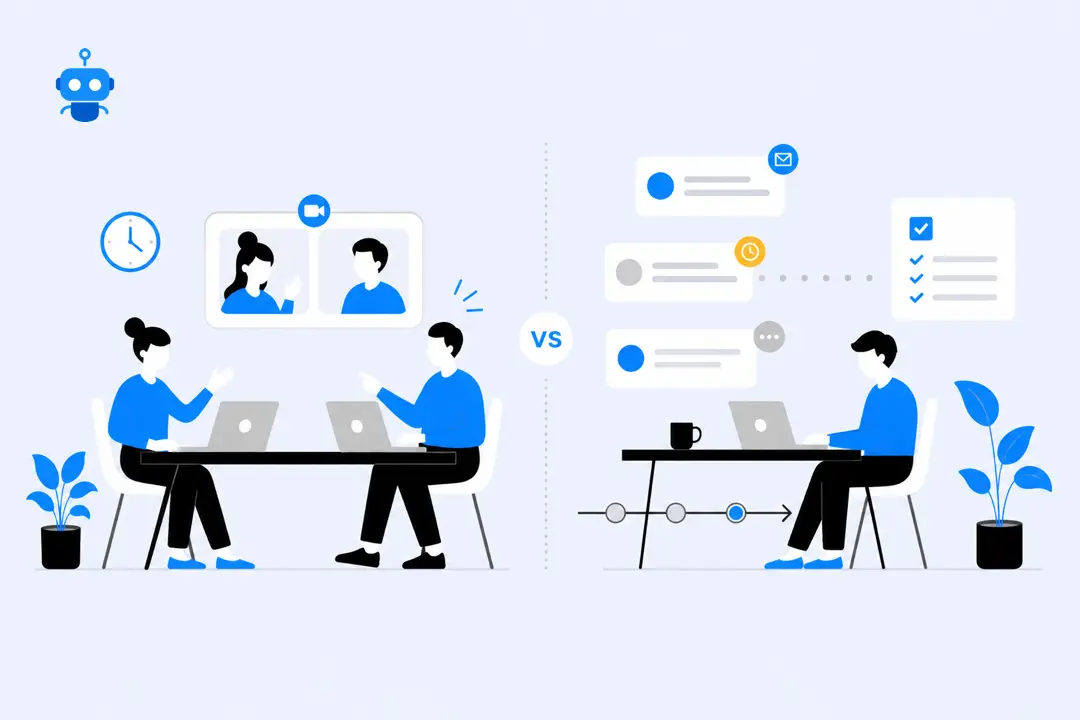
In your workplace, if you want to discuss project details with your teammate you don’t directly interrupt them in between their task. Even if you do then most of the time, they ask you to do an email or slack them so they can check and reply to you after some time. This is an example of asynchronous communication, where the sender gets a response from the receiver after some delay.
You all have sent asynchronous messages knowingly or unknowingly in your organization. In this modern world, where employees are working remotely, messaging applications are widely used for communicating with customers and other employees. Imagine a situation where you have to give a work status update to your manager and when you reach out to them, they tell you to do a message/mail and they can see it later. Now, this method of information sharing is a kind of asynchronous communication. This is different than synchronous communication because you and your manager are not meeting in person or live chatting or video conferencing.
I will discuss a lot more other examples and then you can easily figure out what is asynchronous communication and how it is different than synchronous communication. So, let’s dive in.
What is Asynchronous Communication?
Asynchronous communication can be considered as a kind of communication where there is a delay between the sender and recipient of the information. In layman’s terms, asynchronous communication is communication that does not happen live or real-time over a phone call, video conferencing, or in person.
Now, you are already aware of what exactly is asynchronous communication, so let’s discuss how it is different than synchronous communication.
Asynchronous VS synchronous communication
In synchronous communication, the speaker and listener are in sync and the time the listener receives the information they respond to it and there is no time lag because they both are communicating live or in person. There are several situations where synchronous communication is helpful, for example, Rachel a software engineer wants to discuss a critical problem and does not want the team members to delay the meeting. In this situation, video conferencing or meeting in person would be the best idea rather than waiting for everyone’s response to an asynchronous message. Moreover, in live communication, Rachel can explain it better and other teammates can understand better without any misunderstanding.
One of the main barriers to synchronous communication is the availability of the recipient when you want to share the information or ask for information at that moment. That’s why asynchronous communication came into the picture. Now, I will share what are the other reasons for doing asynchronous communication over synchronous communication.
Benefits of asynchronous communication
There are several benefits of asynchronous messaging and some of them are:
- High performance: When the people are not interrupted in the middle of their task, they perform better and give higher outputs. Asynchronous communication enables people to work with full concentration without sacrificing their high-priority tasks.
- High productivity: People can complete all of their high-priority tasks on time and then respond to the message sent by the sender. This will lead them to deliver multiple tasks on time with high quality.
- Less stress: Switching from one task to another can be a bit hectic and can give extra stress to the employee. Think about a situation where you are in the middle of something critical and someone calls you abruptly, this will create chaos in your mind. Obviously, in any such situation, no one wants to be interrupted.
- Highly qualified working staff: In asynchronous communication, let’s say hybrid or remote work is preferred by the organization then more highly qualified candidates living in different geolocation can apply for the job because the physical meeting is not necessary all the time.
Now, I will talk about asynchronous communication examples.
Asynchronous communication examples:
1. Asynchronous stand-ups in Slack using SUP
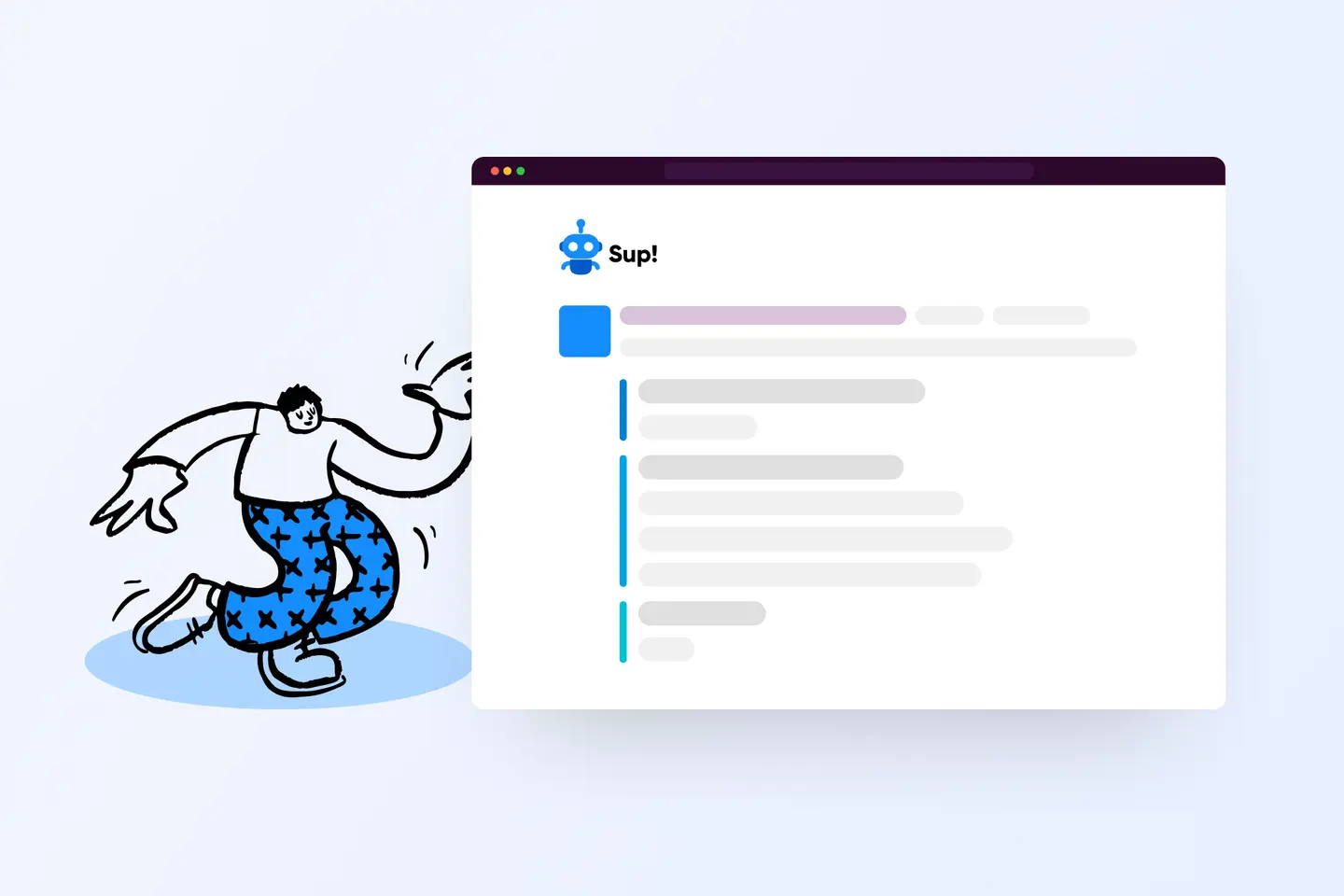
Slack is used as an instant messaging service, but it also enables the user to organize asynchronous stand-up meetings. In a situation where the team has a lot of live stand-up meetings a day or if they do not feel the need to organize it live all the time then they can go for asynchronous stand-ups. One of the suggested tools is Sup Bot. You just need to go to Sup Bot and integrate it with Slack. You can check this blog to read about stand-ups and how you can organize asynchronous stand-ups using Sup. Say, for instance, if you hire remote developers for your company, this is an ideal way to communicate with them.
One of the finest feature of Sup is to manage mood tracking of employees and it is majorly used to determine the productivity of the team members by understanding the moods at the organization. You can also visit this blog to get more insights.
 Add to Slack
 Add to Teams
 Add to Webex
2. Enterprise Social Platforms
In today’s fast-paced work environment, fostering bottom-up communication is essential for organizational success. An enterprise social platform empowers employees to share updates about their projects, celebrate team milestones, and discuss compelling topics. This not only promotes transparency but also enhances collaboration and innovation across teams. HubEngage, a unified communications and engagement platform, delivers a dynamic and feature-rich social platform designed to make these interactions seamless and engaging.
3. Threads and discussion forums
There are several platforms available for sharing high-quality knowledge with people of similar interests. Popular tools are- Quora and Reddit. People can comment there and can also ask their queries if any. Interested people leave replies to their comments. Such forums provide an opportunity to connect with like-minded people.
4. Electronic-mail
Email is the most conventional way to send messages to people for the purpose of sharing a document or asking for a response over a query. It is the asynchronous communication that almost all start-ups and big tech companies prefer.
5. Messaging applications
Messaging applications became more popular because of the rise of the social media world and since then organizations also adopted them. Some companies have their own messenger, and some prefer Slack, WhatsApp, Trello, etc. for live chatting.
6. Project management applications
Project management applications are used to manage a real-time project with the team members. The popular ones are – Rally, Jira, Trello, etc. These platforms offer the project team to check the work progress of each and every other teammate.
Conclusion
Asynchronous communication involves the kind of communication in which there is a time lag between the sender sharing the information and the recipient responding to the information. This includes a lot of benefits which makes it more popular in the online world. Employees do not need to be physically available to connect with other teammates or customers. They do not need to leave their higher priority task in the middle to respond to a lower priority query asked by another teammate. Some of the commonly used tools for asynchronous communication are- instant massagers, email, project team management tools, and Slack in the integration of Sup Bot to organize asynchronous stand-ups.
Can you think of any situation where you would not prefer asynchronous communication?
Frequently asked questions
1. What is asynchronous communication?
Asynchronous communication refers to a method of communication where the sender and receiver do not need to interact with each other in real time. The message sent by the sender can be received, read, and responded to by the recipient at their convenience, creating a time gap between sending and receiving.
2. What is asynchronous example?
Asynchronous communication is common in various digital platforms where immediate responses are not required. Examples include:
- Emails: Exchange information at convenient times.
- Text Messages: Communicate without real-time interaction.
- Online Forums: Post and engage with discussions later.
- Collaboration Tools: Use Slack, Microsoft Teams, etc., to share updates and tasks asynchronously.
- Apps within Collaboration Tools: Tools like Sup Standup Bot in Slack, Teams, Webex to facilitate asynchronous standup meetings.
3. What is an async tool?
Async or asynchronous tools are communication tools allowing users to collaborate from different locations at different times, helpful for teams working from different time zones.
4. What is asynchronous vs synchronous?
Asynchronous communication allows users to interact without requiring them to be present at the same time whereas synchronous communication occurs in real-time, requiring simultaneous engagement.