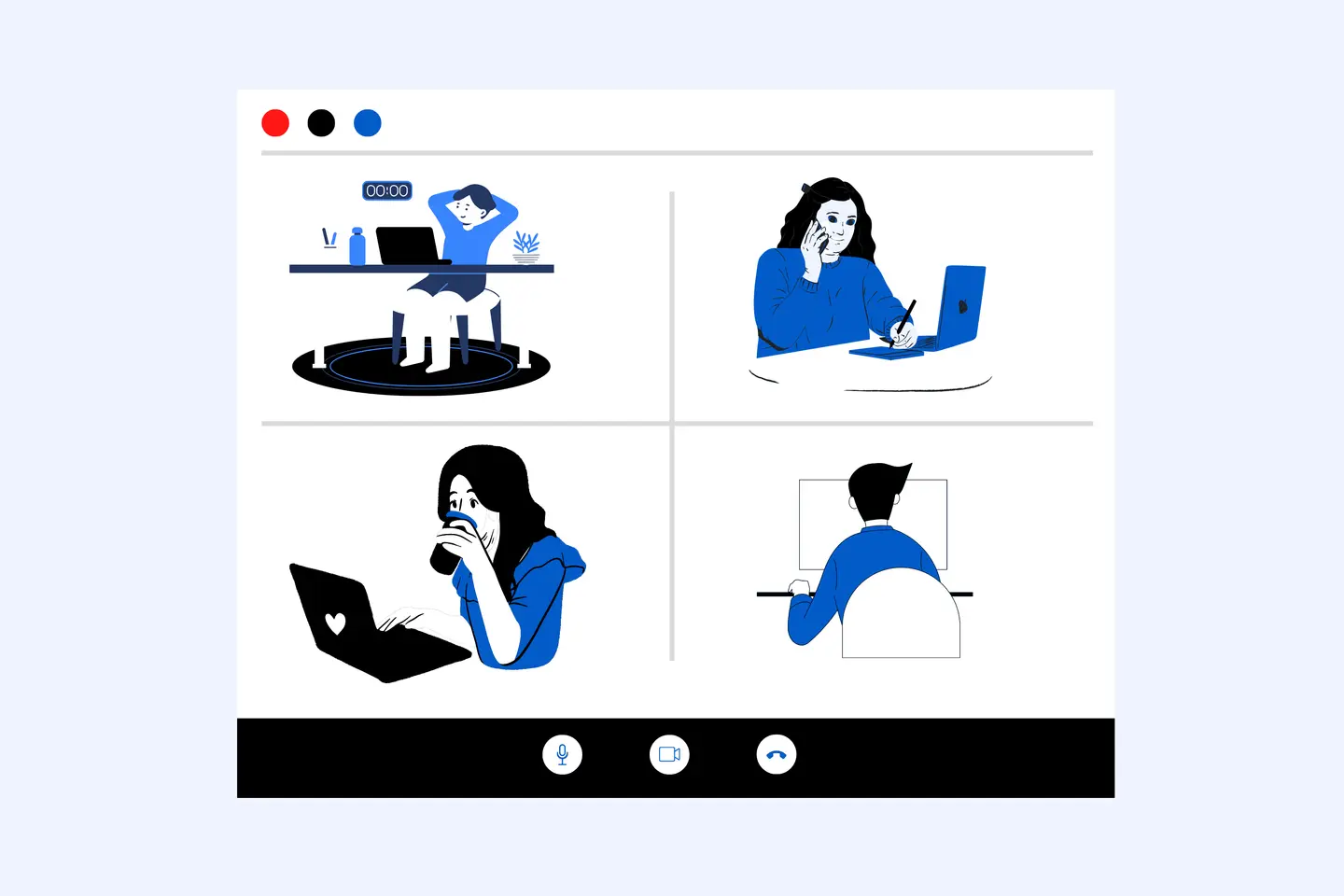

Stand-up meetings have become quite popular owing to their wide adoption and distinct structure. I mention the distinct structure because no other meeting has one as stringent as this. If you do not already know about them, stand-up meetings are brief meetings that require the participants to report progress and mention any issues they are facing.
And what does that said structure look like?
- 1.Time limit: The meeting must not extend beyond 15 minutes.
- 2.Daily questions: The meeting participants must only answer the three daily stand-up questions:
1. What did you do yesterday?
2. What will you do today?
3. Are there any blockers? - 3.Participant limit: The number of participants must be between 10 and 15.
One might wonder about the purpose behind such a structured meeting. Here it is: the stand-up meetings essentially check the progress of the team toward the Sprint goal so that necessary adjustments can be made to the Sprint backlog (the set of items that the team will complete during a Sprint). Since it is only to check the daily progress and nothing else, understandably, the structure was created to keep the focus intact.
1. Traditional stand-up meetings
How daily stand-up meetings came into being is quite a story.
So, Jeff Sutherland and his team repeatedly watched videos of a rugby team performing the Haka dance before their game. Inspired by the vigorous movements, they wanted to find a way to replicate this energy in their meetings.
The search led them to a paper examining a project called Quattro Pro for Windows by the Borland Software Corporation. What they found was nothing short of remarkable - a team of eight had created one million lines of software code in only 31 months!
The careful study of the paper told them that this feat was made possible by a daily gathering of the entire team focusing on daily progress and the active resolution of any hindrances. Sutherland refined this and, on application, found a significant boost in their productivity!
The refinements included the components of the structure mentioned earlier. But one major refinement that Sutherland insisted on was that this meeting had to be run and attended standing. And hence the name.
The thought behind adding this element to the daily stand-up meeting was to ensure that everyone participated actively in the meeting and that the meeting did not stretch beyond the stipulated time. The traditional stand-up meetings are therefore conducted physically and standing.
Advantages of traditional stand-up meetings
Traditional stand-up meetings bring with them their own set of benefits.
- The meetings ensure unnecessary discussions are avoided, lest everyone have to stand longer.
The traditional stand-up meetings, owing to their time-boxed nature, ensure that there is no time to discuss irrelevant topics. So, no one strayed from the meeting agenda. Doing so would mean that meeting participants would have to stand longer, adding to the physical impatience. - The meetings, owing to everyone’s physical presence, have higher engagement and attention.
The traditional stand-up meetings require all stand-up meeting participants to be in physical presence together. This physical gathering makes the meeting participants interact with each other meaningfully and listen actively, leading to higher engagement and attention. - Since it is done face-to-face, people will be more accountable.
The meeting participants know that they will have to come face-to-face with their teammates the next day to report their progress. This pushes them all the more to do work that contributes to the sprint goal. If they don’t and have nothing to report, they become answerable to their entire team about the lack of progress.
Disadvantages of traditional stand-up meetings
The traditional stand-up meeting also has its disadvantages.
- There is no record of information shared in physical stand-up meetings.
Most meetings have someone assigned to take down the minutes of the meeting. However, stand-up meetings require everyone to participate actively and focus on the three questions. With only the required participants attending and no one other than them to take down the minutes, there is no record of information shared in the meeting. - Team members working remotely or from different locations may be excluded or have difficulty participating.
In teams with remote members, holding physical stand-up meetings becomes nearly impossible. Often, remote members may not be invited at all, or if included virtually, their participation may be hindered by inconvenient timing. This can lead to ineffective communication and incomplete information sharing among team members, ultimately impacting collaboration, and overall project success. - Space constraints can make finding a suitable physical space for teams challenging.
Stand-up meetings must ideally have only 10 team participants. Sometimes teams tend to be larger. Accommodating everyone’s schedule and the availability of the meeting room can become a task and a source of stress since daily stand-up meetings must be held every day at the same time. - Noise levels and interruptions in the physical environment can affect the quality and focus of the meeting.
The meeting room may not always be available to provide a noise-insulated space. Even if they are, it may not always be free of interruptions and noise disturbances. This disadvantage of physical stand-up meetings can affect the quality of discussions. - The meetings tend to extend beyond the time limit and may need to be rushed when another team is waiting to use the room.
It is not uncommon for physical stand-up meetings to extend beyond the 15-minute mark. In such situations, it becomes difficult to continue the meeting when there is another team standing outside the room waiting to enter the room. This can cause the stand-up meeting participants to lose their focus and rush their progress updates, compromising the quality of the meeting. - The physical setting can be worrisome for introverted participants.
Traditional stand-up meetings, with their physical structure, can be a source of immense discomfort for introverted or reserved meeting participants. Their inability to express themselves freely can impair the quality of progress updates the team receives during the stand-up meeting. They may also hesitate to mention where they are stuck in fear of drawing attention to themselves.
2. Virtual stand-up meetings
With teams now working with professionals dispersed across continents, physical stand-up meetings gave way to virtual stand-up meetings. The need to get all the team members together led to more and more teams across the world adopting the virtual way of stand-up meetings. The pandemic pushed this trend even further when physical gatherings turned into a source of fear.
Zoom, Google Meet, and Microsoft Teams became the go-to tools to conduct daily stand-up meetings virtually.
Advantages of virtual stand-up meetings
There are reasons why so many teams are adopting the virtual way of stand-up meetings. Here are a few.
- Solves mostly everything related to scattered team meetings.
Virtual stand-up meetings turned out to be a savior for teams working with remote team members. They eased the process of getting the entire team into attendance and receiving progress updates from all, even if a few of them worked remotely.The virtual setup proved beneficial even for teams that usually conducted their stand-up meetings physically but had to work from home due to bad weather conditions or any other reason. - Virtual stand-up meetings can be recorded for a revisit of updates later.
Videoconferencing tools like Zoom and Microsoft Teams allow meeting participants to record their meetings. This means that the problem of lack of records in the physical stand-up meetings has a solution now. Stand-up meeting participants could simply watch the record file when they wanted to revisit the progress updates for specific dates.
Disadvantages of virtual stand-up meetings
Despite their substantial benefits, virtual stand-up meetings are not devoid of challenges either.
- The participants are unclear about how to proceed if the meeting host does not arrive on time.
As in physical stand-up meetings, there are a lot of things that can delay a team member from joining a stand-up meeting, such as their being busy with another call. And if that person happens to be the meeting host, it can become difficult for the stand-up meeting participants.
In the absence of the host, they become unsure of how to proceed with the meeting - if they must wait for the meeting host to join or who will facilitate the meeting in case the meeting host is unable to join. This causes a huge delay and can demotivate the meeting participants. - Managers need to watch the full week’s record to get an understanding of an individual team member’s work progress.
Even when the virtual stand-up meetings can be recorded, the process of revisiting can be overwhelming. Say, if a manager wishes to understand the weekly progress of an individual team member, they will have to go through each video clipping, find the time stamp when the specific team member is reporting their progress, make a note of each day’s progress, and only then will they be able to understand the full week’s progress. - The virtual meeting fails to start if the host is on leave, forcing participants to start a bridge call.
Since it is the meeting host who allows everyone to enter a meeting room on Zoom, their being on leave can impede holding a virtual stand-up meeting. The inability to join the meeting leads team members to start a bridge call. Informing everyone of the same, sending invites, and getting everyone on board consumes a significant amount of meeting time. - Technical issues like connectivity problems, software glitches, etc.
Virtual stand-up meetings are subject to a stable internet connection and the proper functioning of the software used. If any of these misbehave for the meeting participants, they will be unable to attend the stand-up meeting, which can prevent them from sharing their updates or hearing those of others.
Additionally, the sudden logging out of a participant mid-meeting can break the flow and focus of the ongoing meeting when the attention of the rest of the team gets diverted to the missing participant. - Participants might multitask during virtual meetings, reducing their attention and engagement.
The absence of a physical setting allows meeting participants to respond to notifications on their phones (such as an invite for another meeting) or mute themselves to respond to a phone call and multitask. They may do so because they want to make greater use of their time. However, doing so takes their attention away and significantly reduces their engagement in the meeting. The stand-up meetings are then reduced to any other virtual meeting, despite a structure that promotes active participation. - Finding a convenient time for all participants across different time zones can still be challenging.
Virtual stand-up meetings accommodate remote team members. True. However, they do not accommodate the different time zones in which the remote team members work. As a result, remote team members may be forced to join the stand-up meeting at hours that work for the local team but are inconvenient for them. - The prevalence of virtual meetings can lead to burnout and meeting fatigue.
It is common to have more than one meeting on an employee’s schedule. Another virtual meeting with a daily cadence being added to the schedule can increase the likelihood of virtual meeting fatigue. As a result, meeting participants can experience increased cognitive overload, mental strain, physical exhaustion, and decreased focus. - If participants are working remotely from different time zones, the meeting will not be at the start of the day (the ideal time for stand-ups) for many of them.
Daily stand-up meetings must ideally be held at the start of the day to ensure clarity of tasks before one starts working. However, when a team works with remote team members from different time zones, the start of the day will vary for team members. For example, 9 a.m. in the USA is 10 p.m. in Japan. So, conducting stand-up meetings virtually fails the purpose of the stand-up meetings for members working from different time zones.
3. Asynchronous stand-up meetings
Asynchronous communication is when the sender and the receiver of the message are not present together in real-time, and therefore, it is expected that the response to the message sent will not be immediate.
Today, stand-up meetings are also conducted asynchronously using asynchronous stand-up bots such as Sup Bot.
 Add to Slack
 Add to Teams
 Add to Webex
The process is simple.
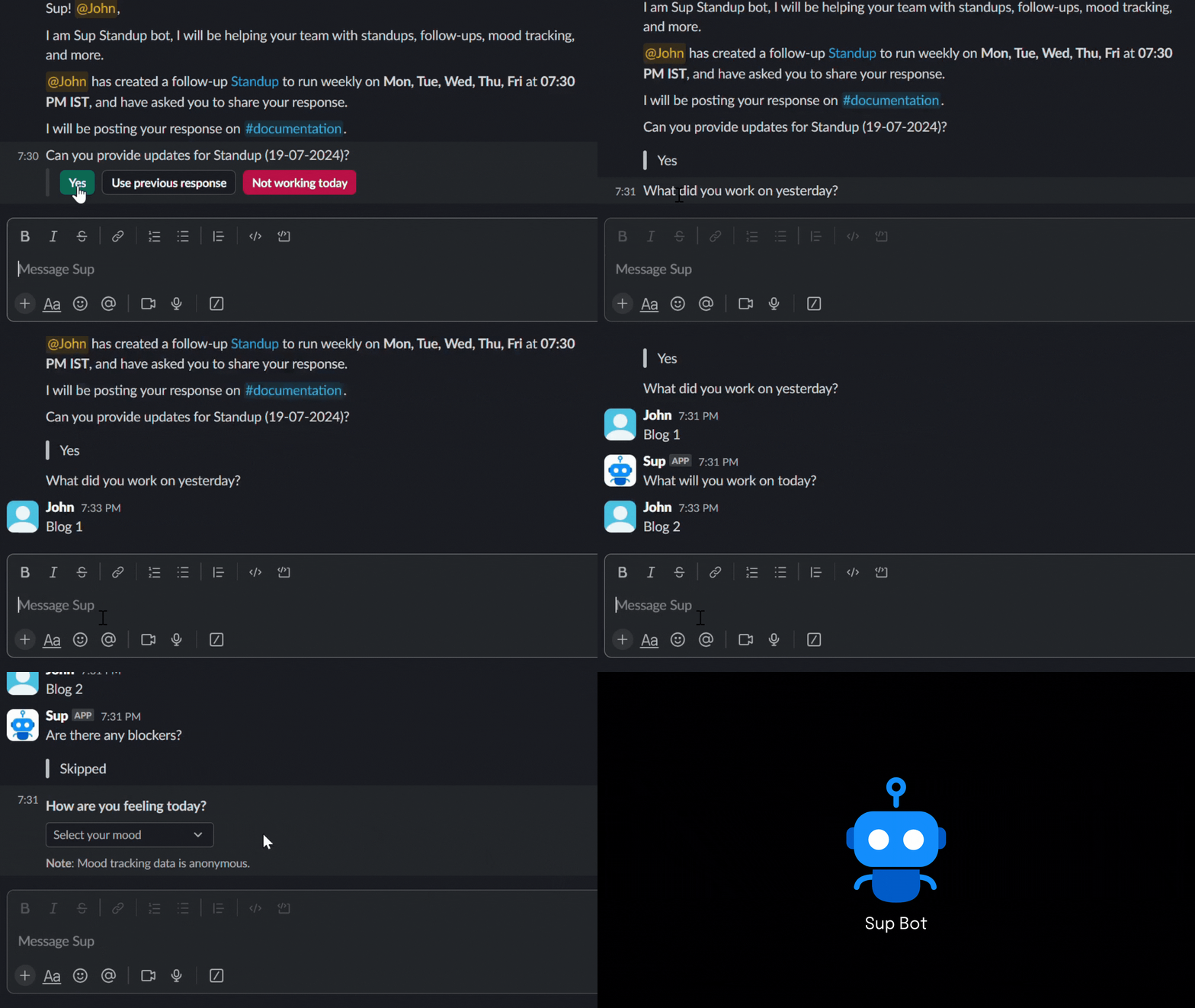
- The users receive a notification on the official communication platform like Slack, MS teams, Webex to submit answers to the three stand-up questions at a scheduled time.
- They type down the answers to the questions.
- They are posted to a common channel or space that includes the rest of the team members.
Advantages of asynchronous stand-up meetings
Today, asynchronous stand-up meetings have become quite popular because they come with numerous benefits.
- Encourages detailed updates as there is no time limit.
Asynchronous stand-up meetings do not allot individual time limits for meeting participants to speak (for example, 1 minute per person) as in physical or virtual stand-up meetings. Therefore, meeting participants can take their time to carefully craft their stand-up answers and make them as detailed as they want.
This enables comprehensive and effective progress updates that might not be feasible within the time constraints of physical or virtual stand-up meetings. - Enhances record-keeping, allowing the written updates to be reviewed multiple times to identify a trend.
As can be seen in the GIF above, the asynchronous stand-up bots make use of text-based communication. These written progress updates are sent to the channel or space with the rest of the stand-up meeting participants and also stored in the database. This way, both team members and managers have access to the stand-up meeting updates that they can view as many times as they want.
This easily available data can also be filtered on Sup Bot to observe a pattern over a fixed duration (such as a week, month, or year) and understand how individual team members work. - The written records of updates accord greater transparency and accountability.
When progress updates for stand-up meetings are posted daily to a space or channel with all the team members, it becomes important for all to contribute meaningfully to the team daily. This is because the written progress updates are visible to all. Such clear visibility of work makes the team members accountable to each other for their daily progress. This also makes it easier to track individual contributions.
The greater transparency and accountability accorded by the asynchronous stand-up meetings thus ensure productive work from all. - Increases inclusivity.
Asynchronous stand-ups provide a platform for team members with language barriers or different communication styles to participate fully, promoting a diverse and inclusive team culture. They are also advantageous for team members with physical challenges or those who are pregnant, allowing them to participate comfortably. Furthermore, they create an inclusive environment where all team members, regardless of personality type, can contribute effectively. Introverted participants, who often feel uneasy in live stand-up meetings, can share detailed updates comfortably without being rushed, ensuring everyone has an equal chance to contribute and preventing dominant voices from overshadowing others. - They can accommodate teams of any size without increasing meeting time.
Synchronous stand-up meetings (physical and virtual) can become time-consuming as team size grows because of the need to participate at the same time. However, asynchronous stand-up meetings allow participants to provide their progress updates at their convenience, giving managers the freedom to increase team size without worrying about the time wasted in meetings. - They eliminate the inconvenience of remote workers having to join the meeting at odd hours.
With asynchronous stand-up bots like Sup Bot, remote team members can submit their stand-up responses at the scheduled time but in their local time zones. This is made possible with asynchronous stand-ups at user time zones.
This means that team members working from different time zones will not have to attend the stand-up meetings at hours that are inconvenient for them. - Team members do not have to wait for other participants to speak their turn.
The lack of real-time synchronicity significantly makes it convenient for participants to simply type their progress updates when they receive a notification instead of waiting for their turn. This approach keeps everyone focused and efficient, no matter how many people are involved. - No more sitting through unrelated updates.
Today, a product development team includes members from different departments working cross-functionally. It may happen that a few team members have shared their progress updates and are only waiting for the stand-up meeting to end. This is because the progress updates being shared are unrelated to their work, and they are forced to sit instead of starting their work.
Asynchronous stand-up meetings remove this inconvenience from stand-up meetings, allowing all meeting participants to begin with their tasks as soon as they submit their stand-up responses. - Standup meetings adhere strictly to the standardized time limit.
Both physical and virtual stand-up meetings run the risk of getting extended beyond the 15-minute mark. However, it is not so with asynchronous stand-up meetings. The asynchronous nature of these meetings strictly complies with the time limit stated by Sutherland. This is because the meeting for each meeting participant ends the moment they submit their responses and finish reading the relevant progress updates of other team members (which hardly takes more than 5 minutes). - Detailed analytics.
Physical stand-up meetings do not have a record of the shared progress updates. Virtual stand-up meetings are recorded as videos. So, it becomes impossible for either of them to generate analytics from the shared updates.
However, asynchronous stand-up bots such as Sup Bot store the written responses and provide statistics and analytics derived from them. They share insightful information that can help managers streamline workflows. - The data stored is organized and easily accessible.
Asynchronous stand-up bots keep data organized, making it easy to access with filters. This contrasts with Zoom or Microsoft Teams recordings, where finding specific information means searching through timestamps. - They reduce the risk of virtual meeting fatigue.
Asynchronous stand-up meetings take one meeting away from the list of virtual meetings. The stand-up meetings, being a daily affair, can add to potential Zoom fatigue if conducted virtually. Thus, asynchronously conducting stand-up meetings reduces the likelihood of virtual meeting fatigue.
Disadvantages of asynchronous stand-up meetings
Asynchronous daily stand-up meetings can also be challenging in the following ways:
- The lack of access to an internet connection can hinder the process of submitting a stand-up update.
Asynchronous stand-up meetings are incumbent on a stable internet connection. Thus, if there is no internet connection or a sudden disruption, the meeting participants cannot submit their progress updates. - With no fixed time, participants can delay submitting their progress updates.
Asynchronous stand-up meetings are scheduled for a certain time, but since they need not be answered immediately, meeting participants can delay answering them. This can result in other team members not receiving all progress updates promptly, leading to gaps in communication and leaving them less informed.
Transform your stand-up meetings with Sup Bot.
Sup Bot brings the future of stand-up meetings to you with its automated and asynchronous stand-up meetings. With flexibility and efficiency being the new norm at most workplaces, Sup Bot equips you with the right features to easily adopt them. Sup Bot, one of the best tools to drive productivity, is trusted by thousands of changemakers. Join them now!
Frequently asked questions
1. What is an asynchronous stand-up meeting?
In an asynchronous stand-up meeting, participants report their daily progress updates to the team without coming together in real-time. These meetings are typically conducted using third-party apps like Sup Bot integrated into the company's official collaboration tools. They are text-based and allow team members to share their accomplishments, upcoming tasks, and any obstacles they face. They provide flexibility, increase accountability, enhance productivity, and reduce the risk of virtual meeting fatigue.
2. What is a virtual stand-up meeting?
Virtual stand-up meetings are daily stand-up meetings that are conducted using video conferencing tools like Zoom and Microsoft Teams. They allow remote team members to participate in the daily stand-up meetings, which would have been difficult if the meetings were conducted physically. Other than this, they are similar to physical stand-up meetings in their structure - the team gathers at a scheduled time to report their daily progress and mention their blockers. However, they are reliant on a stable internet connection, the absence of which can make it impossible to conduct them.
3. Why is daily stand-up 15 minutes?
A daily stand-up meeting must not extend beyond 15 minutes to ensure the team is focused on the stand-up meeting agenda. Proposed by Jeff Sutherland, the short duration ensures that the discussions in the stand-up meeting are relevant - that the answers to the three stand-up questions are concise without including any unnecessary details. The short duration also reminds the meeting participants that the meeting is not for problem-solving but only for highlighting them. This keeps the meeting efficient and effective.
4. What is the purpose of a stand-up meeting?
The purpose of a daily stand-up meeting is multifold.
- Ensures alignment towards goals: It establishes alignment towards Sprint goals by getting all the team members together daily to update the team on progress.
- Promotes accountability of work: The meetings ensure that participants feel answerable for their daily work and thus work responsibly.
- Enables effective communication: When team members report to each other daily about their progress and plans for the day, they ensure everyone is updated.
- Facilitates early identification of impediments: Daily stand-up meetings ensure that any obstruction to work is highlighted daily for immediate redressal after the meeting.
5. How do I run an asynchronous meeting?
You can run an asynchronous meeting using tools such as Sup Bot. Here are the six simple steps to an effective asynchronous meeting:
- Log in to Sup Bot.
- Select follow-ups and choose the required template, or create your own.
- Select the interaction type and the required details.
- Select the channel or team space.
- Add or modify questions.
- Add customizations and create an asynchronous meeting.
Your team members will receive the notification and can add their responses to the questions asynchronously.
6. What are the rules for stand-up meetings?
The daily stand-up meetings have several rules.
- They must not be run for more than 15 minutes. This short duration of stand-up meetings ensures that the meeting participants do not deviate from the agenda.
- They must not have more than 10 participants. This facilitates effective communication within the short duration of 15 minutes.
- Only three questions must be answered. The three stand-up questions require the meeting participants to share their progress, their plan for the day, and any impediments to their work.
- They must be held standing. This ensures that the meeting participants participate actively in the meeting.