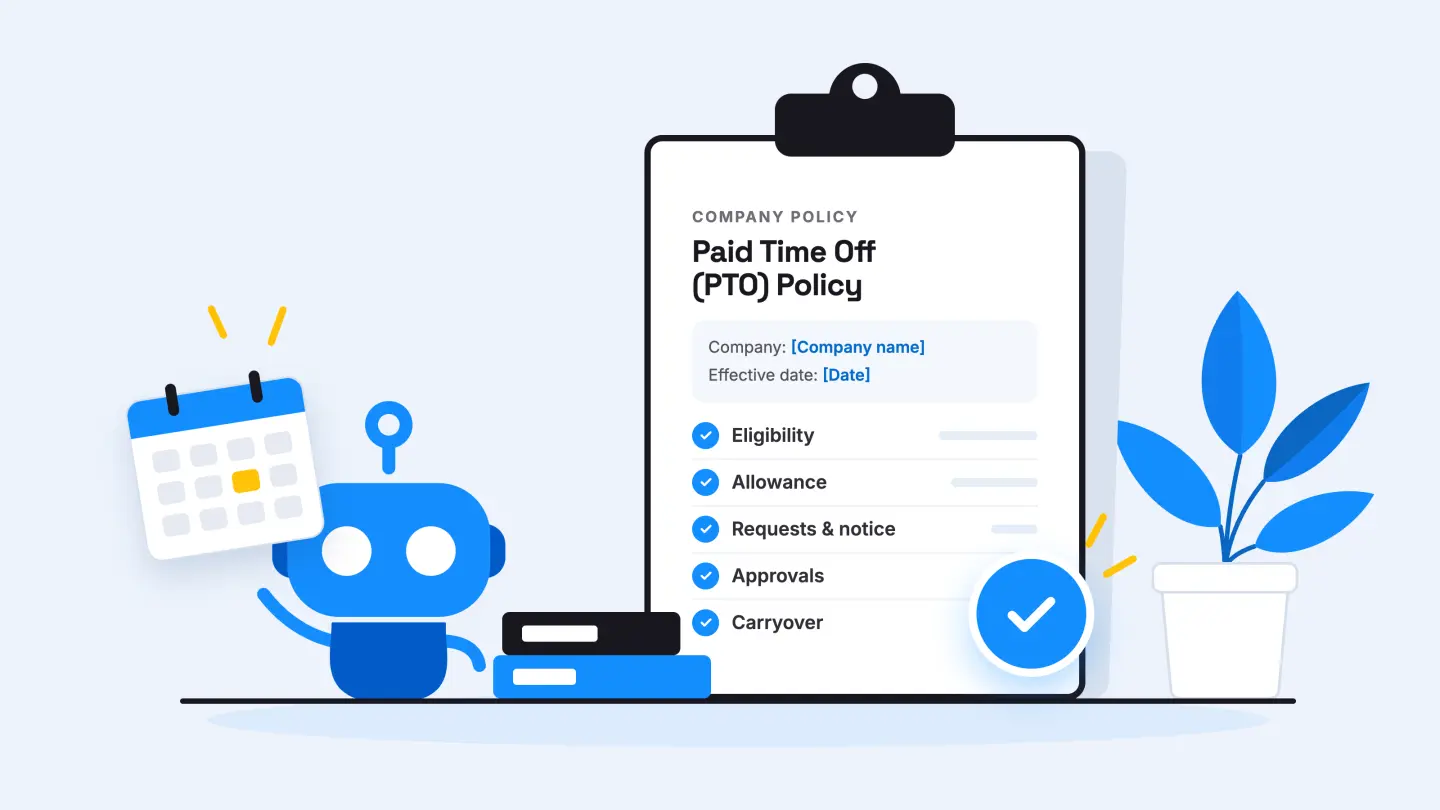
A good PTO policy template does more than tell employees how many days they can take off. It answers the awkward questions before they become awkward conversations: Who qualifies? How early should someone request a vacation? What happens when two teammates want the same week off? And who actually approves it?
For HR teams and founders, the goal is not to write a document full of legal-sounding language. It is to create a clear, fair process that employees can understand and managers can apply consistently. This guide walks through the decisions worth making first, then gives you two copy-ready policies to customize: a formal HR version and a friendly, plain-English version.
Important: This is an operational template, not legal advice. Paid leave, protected sick leave, carryover, final payouts, and notice requirements vary by location. Have a qualified local adviser review your final policy before publishing it.
What should a PTO policy include?
At minimum, employees should be able to find the answers to these questions without messaging HR:
- Eligibility: Who is covered, and when does coverage begin?
- Allowance: How much time is available, and how is it earned?
- Leave categories: Which absences use the PTO balance, and which follow separate rules?
- Requests: Where are requests submitted, and how much notice is expected?
- Approval: Who decides, and what happens when schedules conflict?
- Carryover: Can unused days move into the next year?
- Restricted periods: Are there blackout dates or staffing limitations?
- Departures: How is unused time handled when employment ends?
The policy should also say who owns it, when it takes effect, and how employees will hear about changes.
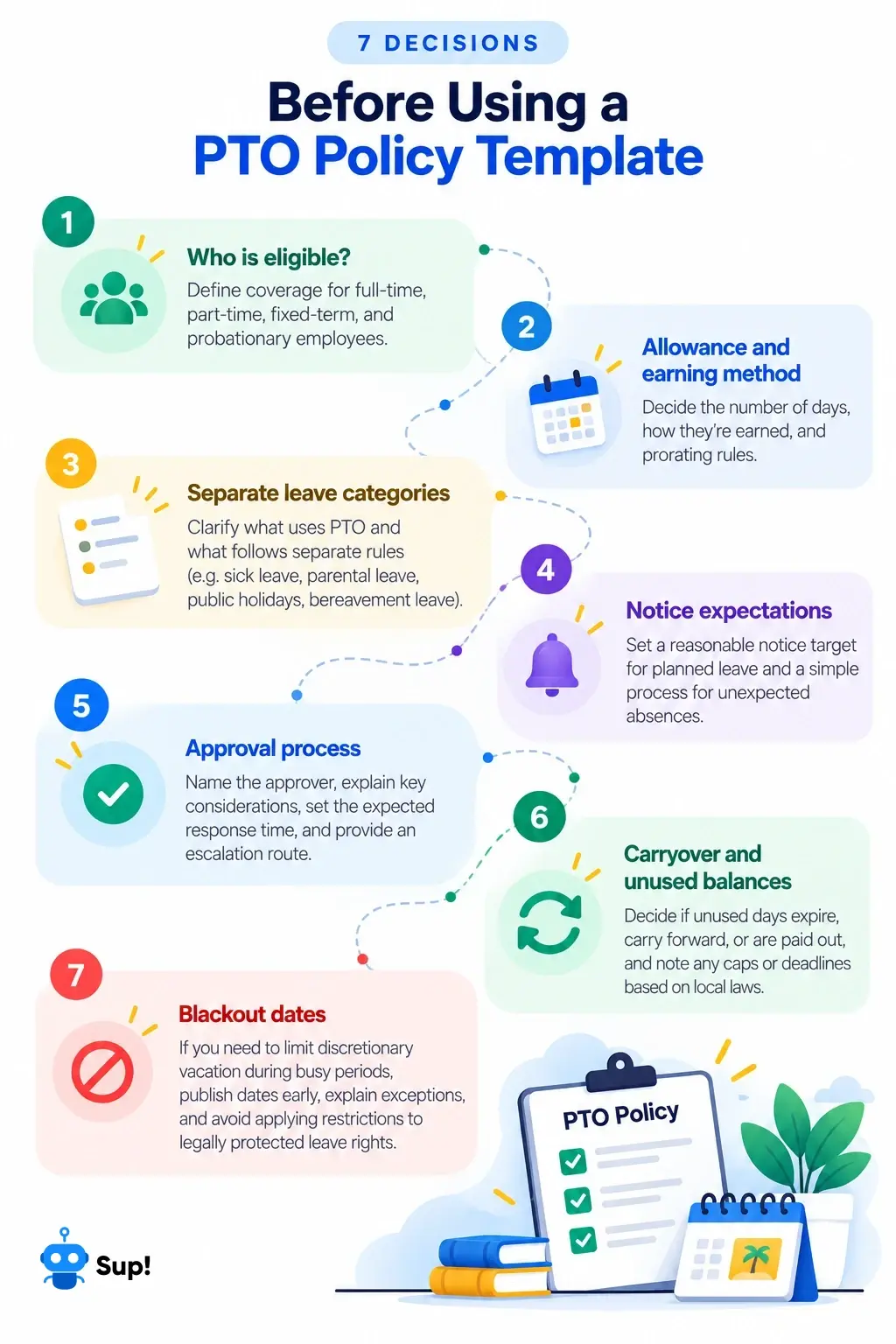
Seven decisions to make before using a PTO policy template
1. Decide who is eligible
Specify whether the policy covers full-time, part-time, fixed-term, and probationary employees. If entitlements differ, explain the differences rather than relying on vague wording such as “eligible staff.” State how new hires are treated and whether time off is prorated.
Do not assume that a company eligibility rule can override statutory leave rights. Legally protected leave may apply even when an employee is outside your standard vacation program.
2. Choose the allowance and earning method
Will employees receive a yearly balance upfront, earn days throughout the year, or follow another arrangement? Define the policy year, any prorating rules, and how balances are shown. If you use accrual, link employees to a clear explanation rather than packing formulas into the handbook.
For the calculation methods and examples, see our guide to PTO accrual.
3. Separate PTO from other leave where necessary
A single PTO bank can be convenient, but it is not appropriate everywhere or for every absence. Sick leave, parental leave, public holidays, bereavement leave, and other protected categories may have separate requirements. Decide which types are covered by the general policy and which need dedicated sections or documents.
For a jurisdiction-specific example, explore our overview of leave types and policies in India.
4. Set realistic notice expectations
Planned vacations benefit from advance notice, but illness and emergencies rarely arrive on schedule. You can set a normal notice target for foreseeable leave while providing a separate route for unexpected absences. Make it clear that notice expectations are subject to applicable law and reasonable exceptions.
A useful rule is to ask for as much notice as reasonably possible, with a published target for routine requests and a simple way to notify a manager in emergencies.
5. Make approvals predictable
Name the approver and explain what they consider: team coverage, previously approved leave, business-critical deadlines, and fair treatment of competing requests. State the expected response time and who employees can contact if their manager is unavailable.
Avoid promising that every request will be approved, but avoid making approvals feel arbitrary. A written escalation process helps when an employee disagrees with a decision.
6. Decide on carryover and unused balances
Will unused days expire, carry forward, or be paid out? Are there caps or deadlines? These decisions affect employee expectations and may be restricted by local law. Specify the rule only after checking the locations where your team works.
If different jurisdictions require different treatment, use a short location-specific addendum rather than pretending one global rule works everywhere.
7. Handle blackout dates carefully
Some teams need additional coverage during launches, audits, or seasonal peaks. If you plan to limit discretionary vacation during those periods, publish dates early, explain exceptions, and avoid applying restrictions to legally protected leave. A blackout period should be a transparent staffing measure, not a surprise reason to reject requests.
Free PTO Policy Template You Can Copy and Customize
Which PTO policy template is right for your team? The formal HR version is useful for an employee handbook or a growing organization that needs precise administration. The employee-friendly version works well for a startup or a team that values plain language. Both cover the same essential decisions, so choose one style rather than publishing conflicting policies.
How to use: Choose the version that suits your organization, copy that complete policy, replace the bracketed fields, remove options that do not apply, and obtain jurisdiction-specific HR or legal review before adopting it. Publish one approved policy, not both versions.
Template 1: Formal HR PTO Policy
Best for employee handbooks and organizations that prefer structured, administrative policy language.
Formal HR PTO policy
Paid Time Off (PTO) Policy
Company: [Company name]
Effective date: [Date]
Policy owner: [HR team or responsible role]
Applies to: [Employee groups and locations]
1. Purpose
This policy establishes the rules for requesting, using, approving, and tracking paid time off. It is intended to support employee rest and consistent administration.
2. Eligibility
This policy applies to [eligible groups]. Eligibility starts [on hire / specified date], subject to applicable law. Partial-year and part-time entitlements follow [prorating rule]. Statutory leave rights remain unaffected.
3. Entitlement and balance
Eligible employees receive [X] days per [calendar / employment] year, [granted upfront / accrued on an approved schedule]. Half-days are [permitted / not permitted]. Balances are recorded in [system]. Public holidays and protected leave follow [separate rules].
4. Planned leave requests
Submit requests through [channel] at least [X working days] in advance where reasonably possible. Include dates and necessary handoff information. Approval is required before treating the request as confirmed.
5. Unexpected absences
For illness or emergencies, notify [contact] through [channel] as soon as reasonably practicable. Documentation requests, confidentiality and protected-absence rules follow applicable law and separate leave policies.
6. Approvals and coverage
[Manager / approver] reviews discretionary requests considering coverage, existing approvals, business needs and consistent criteria. Target response time: [X working days]. Escalations go to [contact]. Protected leave is handled under applicable requirements.
7. Carryover and separation
Unused PTO follows [approved carryover cap, deadline or payout rule]. On separation, accrued and unused balances are handled under [company rule and applicable law]. Mandatory rights take precedence.
8. Restricted scheduling periods
Where lawful, discretionary vacation may be limited during [defined dates or events]. Restrictions will be announced in advance where possible and will not override protected leave rights.
9. Policy management
[Policy owner] maintains this document and communicates changes through [channel]. Employees should direct questions or balance disputes to [contact]. Where this policy conflicts with law, applicable law governs.
Template 2: Employee-Friendly PTO Policy
Best for startups and teams that prefer a warm, straightforward explanation of their rules.
Employee-friendly PTO policy
Paid Time Off (PTO) Policy
Company: [Company name]
Effective date: [Date]
Last updated: [Date]
Policy owner: [HR / People Operations]
1. Our approach to time off
We believe time away from work matters. This policy explains how much time you have, how to request it, and what happens to unused days.
2. Who is eligible?
[Full-time / part-time / other] employees can use PTO starting [date or eligibility rule]. If you join or leave during the year, we calculate your allowance using [prorating rule], where permitted by law.
3. How much PTO do you get?
You receive [X] paid days off per [year period]. Your PTO is [granted upfront / earned monthly]. Half-days are [allowed / not allowed]. Check your balance in [system]. Public holidays and other protected leave follow [separate policy].
4. How do you request time off?
Check your balance, submit your dates in [system], and aim to give [X working days] of notice. Your manager will respond within [X working days]. Once approved, the dates appear in [calendar / system].
5. What if something unexpected happens?
If you're sick or have an emergency, tell [manager / HR] as soon as you reasonably can. You do not need to meet the normal vacation notice target where an exception or legal protection applies.
6. How are requests approved?
We try to approve requests while keeping the team covered. Your manager considers existing time off, workload and fairness. If dates cannot work, they will explain why and discuss alternatives. Questions can go to [HR contact].
7. Can you keep unused days?
Our carryover rule is [rule], with a maximum of [X days / no cap] and a use-by date of [date / not applicable]. When you leave the company, remaining PTO is handled under [rule] and applicable law.
8. Are any dates restricted?
Some busy periods may need extra coverage: [dates / none]. We will communicate restrictions early, consider exceptions and respect protected leave rights.
9. Questions?
Not every situation fits neatly into a rule. Ask [HR contact] about balances, approvals or special circumstances. We will review the policy regularly and explain important changes. Taking time off is encouraged.
Note: These templates are editorial examples, not a guarantee of legal compliance. Sick leave, carryover, payout, restrictions, and eligibility may require country- or state-specific provisions. For multi-jurisdiction teams, use approved location-specific addenda.
How to roll out your PTO policy without confusion
Before announcing the policy, ask a manager and an employee to test it against three realistic situations: a vacation booked months ahead, an unexpected sick day, and overlapping requests during a busy week. If either person cannot identify the next step, revise the wording.
Then publish the approved policy in one accessible location, explain when it takes effect, and show employees where to submit requests and view their balances. Train managers on consistent decisions and establish a process for correcting records.
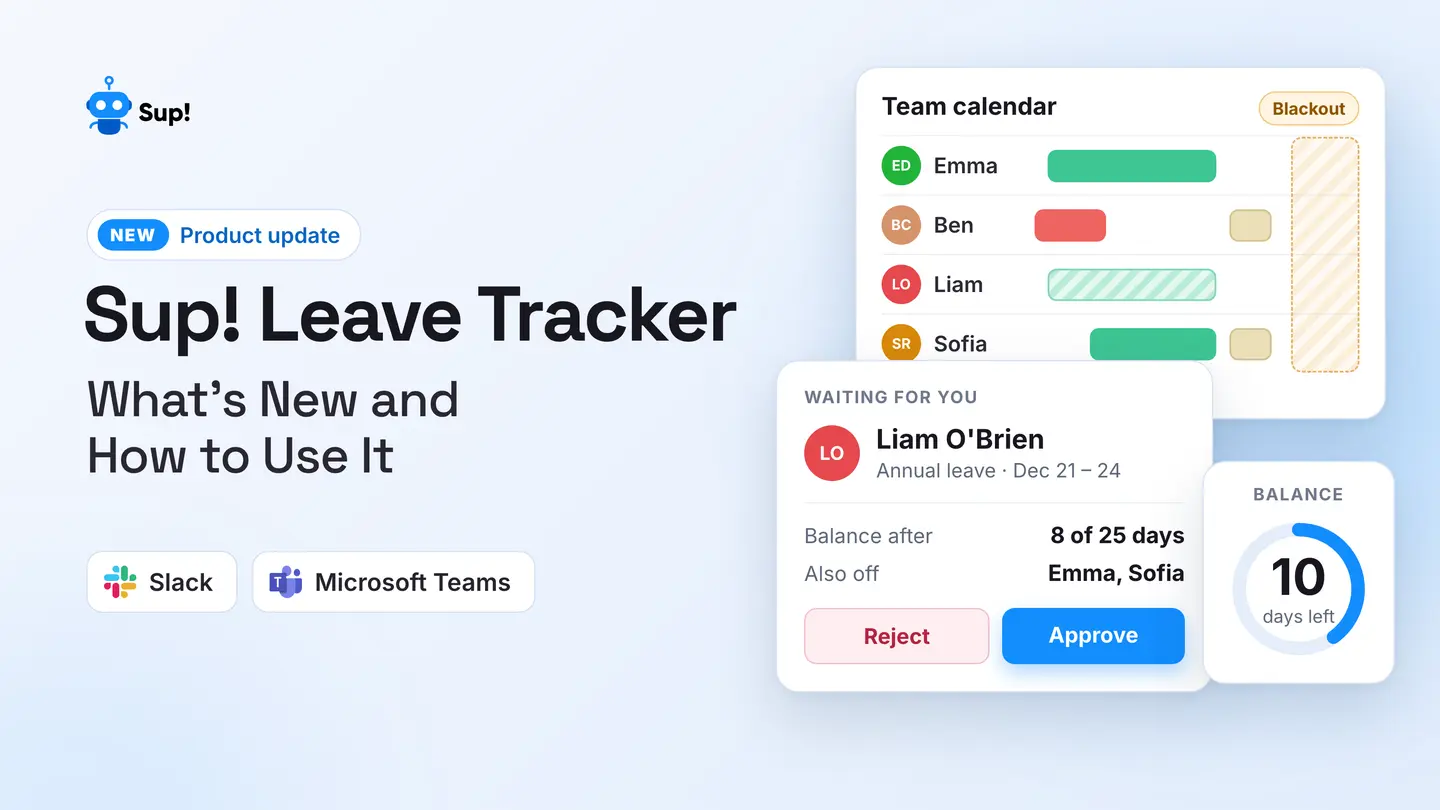
A PTO and leave tracker can support the day-to-day process. Sup! supports leave requests and approvals, customizable leave types, team-based quotas, calendar views, and notifications in Slack and Microsoft Teams. Your written policy still determines the rules; the tool helps teams follow them.
Common PTO policy mistakes to avoid
A policy can look complete and still create problems in practice. Watch for language that gives managers unlimited discretion, combines legally distinct leave types without review, leaves unused balances unexplained, or treats emergencies like planned holidays.
Another common gap is publishing the policy without defining who maintains it. Assign an owner, review it when laws or company practices change, and communicate material revisions clearly. The best policy is not the longest one. It is the one people can actually use.
Conclusion
A PTO policy should make taking time off straightforward, not turn every vacation request into a negotiation. Start with eligibility, allowance, notice, approvals, carryover, and scheduling restrictions. Then choose a version of the free template and adapt it to your workforce and local requirements, review it carefully, and publish one reliable process for everyone.
Once the rules are clear, keeping requests and team calendars organized becomes much easier. If your team already works in chat, explore Sup!'s PTO tracking features as a practical way to support the policy day to day.
 Add to Slack
 Add to Teams
FAQs
Is a PTO policy legally required?
Requirements depend on where employees work and what types of leave are involved. Some jurisdictions mandate written notices or policies for particular leave entitlements, while others do not require a general vacation policy. Even where a written PTO policy is optional, documenting the rules can improve consistency. Have local counsel check the requirements that apply to your team.
Can a company have different PTO policies for different employees?
Companies may distinguish employee groups or locations where the law allows it, but differences should be documented, justified, and applied consistently. Protected leave, contractual rights, and nondiscrimination rules still apply. For distributed teams, a core policy with location-specific addenda is often clearer than one document that hides important exceptions.
Should sick leave be included in a PTO bank?
It depends on local requirements and your company's approach. Some organizations combine discretionary time off into one bank, while others keep sick leave separate. A combined bank must still satisfy applicable sick-leave protections, including any special rules about eligibility, documentation, or permitted uses.
How often should a PTO policy be reviewed?
Review it at least annually as a practical governance habit, and sooner when employment laws, operating locations, staffing patterns, or benefits change. Check whether managers are applying approval rules consistently and whether employees understand balances and request procedures. Keep a version date so everyone knows which policy is current.